 -
-Forming a successful partnership can be the difference between growth and frustration for american small business owners and freelancers. Around 60 percent of business collaborations stumble when legal frameworks are unclear, leading to expensive disputes and dissolved ventures. Navigating partnership agreements allows you to create a solid foundation, clarifying each person’s rights and duties from the start. This guide breaks down key elements for legally sound and customizable contracts that help protect your business without high attorney fees.
Table of Contents
- Defining A Partnership Agreement In Business
- Types Of Partnership Agreements Explained
- Key Clauses And Legal Requirements
- Rights, Duties, And Liability Of Partners
- Common Pitfalls And How To Avoid Them
Key Takeaways
| Point | Details |
|---|---|
| Partnership Agreement Importance | A partnership agreement establishes the framework for collaboration and protects all parties by outlining roles, responsibilities, and expectations. |
| Types of Partnerships | Understand various partnership structures—general, limited, and LLPs—to choose the most suitable one for your business needs. |
| Key Clauses | Include essential clauses like capital contributions and dispute resolution to ensure clarity and legal protection in business operations. |
| Avoiding Pitfalls | Regular communication and clearly defined roles are crucial in maintaining partnership effectiveness and preventing conflicts. |
Defining a Partnership Agreement in Business
A partnership agreement is a legally binding contract that establishes the foundational framework for two or more individuals entering a business collaboration. When entrepreneurs decide to combine their skills, resources, and vision, this critical document serves as a roadmap defining how partners will work together, manage financial responsibilities, and resolve potential conflicts.
Partnerships represent a flexible business structure where individuals jointly operate a business venture/17%3A_Partnerships) with shared profits, losses, and operational duties. Unlike more complex corporate structures, partnerships offer simpler formation processes and greater management autonomy. They can emerge through explicit contracts or even implied arrangements when individuals collaborate toward common business objectives.
The core elements of a comprehensive partnership agreement typically include detailed provisions about each partner’s financial contributions, profit and loss distribution, individual roles and responsibilities, decision making protocols, and procedures for resolving disputes or managing partner exits. These agreements protect all parties by establishing clear expectations and preventing potential misunderstandings that could potentially damage professional relationships or lead to legal complications.
Pro tip: Before finalizing any partnership agreement, consider consulting with a legal professional who can help customize the document to your specific business needs and ensure all critical elements are comprehensively addressed.
Types of Partnership Agreements Explained
Businesses can structure partnerships in several distinct ways, each offering unique advantages and legal implications. Partnership types vary significantly in terms of management control, liability protection, and operational flexibility, making it crucial for entrepreneurs to understand their options before committing to a specific structure.
The most fundamental partnership types include general partnerships, limited partnerships, and limited liability partnerships (LLPs). A general partnership represents the simplest form, where all partners share equal management responsibilities and personal liability for business debts. Limited partnerships introduce a more complex structure, allowing some partners to have reduced financial risk and limited involvement in daily operations, while other partners maintain full management control and corresponding liability.
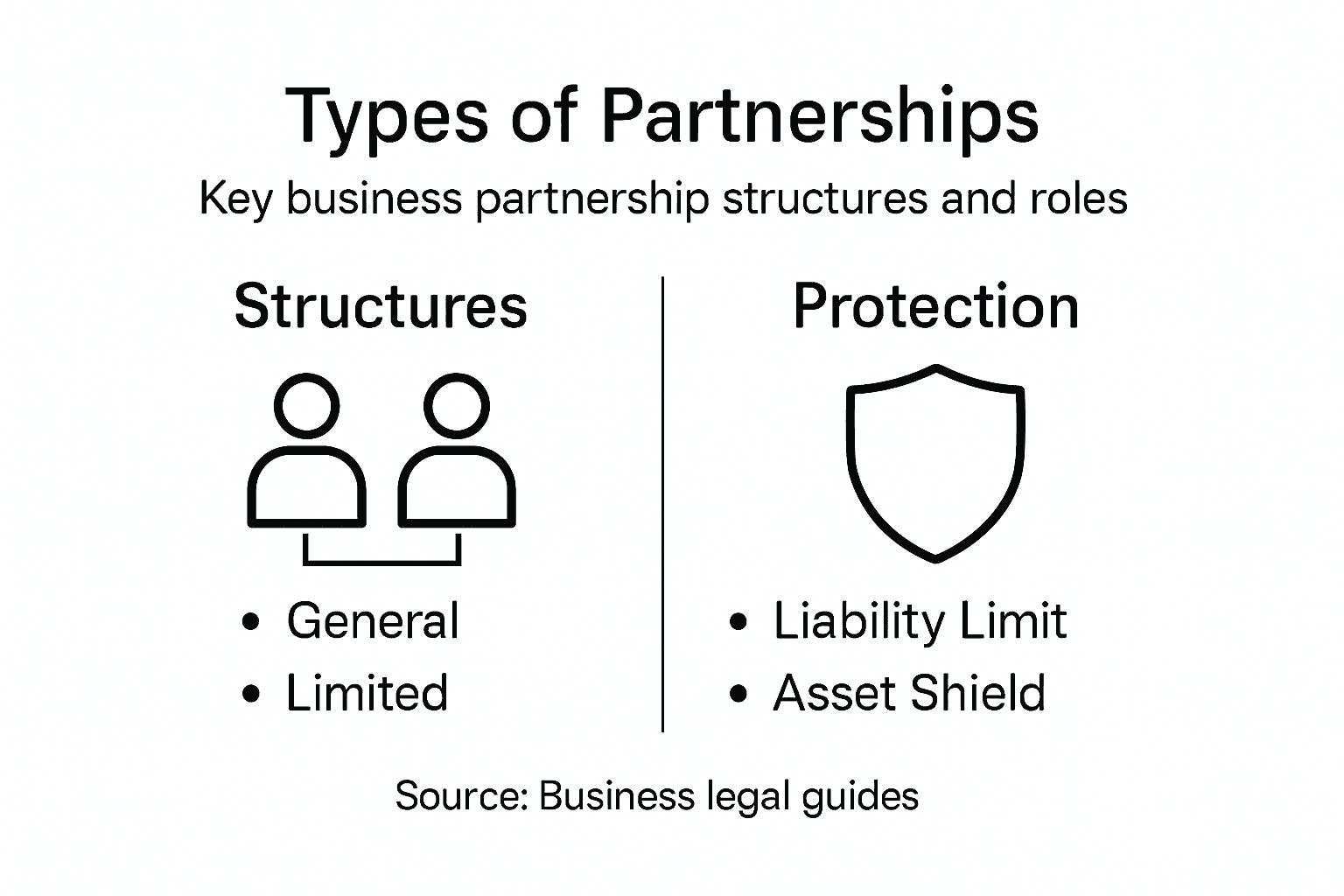
Limited liability partnerships (LLPs) provide the most protection for individual partners, particularly popular among professional service firms like law and accounting practices. In an LLP, partners are generally shielded from personal liability for the negligent actions of other partners, offering a critical layer of legal protection. These partnerships require more formal documentation and often involve specific regulatory compliance measures that distinguish them from more traditional partnership models.
The following table highlights the main differences among common partnership types:
| Partnership Type | Management Structure | Liability Exposure | Typical Use Cases |
|---|---|---|---|
| General Partnership | Equal participation by all partners | Unlimited personal liability | Small businesses, professional firms |
| Limited Partnership | General partners control, limited partners invest only | General partners fully liable, limited partners risk only their investment | Real estate ventures, investment groups |
| Limited Liability Partnership (LLP) | Partners share management | Partners shielded from each other’s liability | Law firms, accounting practices |
Pro tip: Consult with a business attorney to carefully evaluate which partnership structure aligns best with your specific business goals, risk tolerance, and long-term strategic vision.
Key Clauses and Legal Requirements
A comprehensive partnership agreement must address multiple critical legal components to protect all parties involved. Articles of partnership establish fundamental guidelines that define the operational framework, rights, and responsibilities of each business partner, serving as a crucial legal roadmap for collaborative ventures.
The most essential clauses in a partnership agreement typically include capital contribution requirements, profit and loss distribution mechanisms, partner roles and responsibilities, and dispute resolution protocols. Partners must explicitly outline each individual’s financial investments, specify how business earnings will be shared, and clearly define the scope of each partner’s management authority. This level of detail helps prevent potential conflicts by establishing transparent expectations from the outset.
Key legal requirements extend beyond basic operational details to include comprehensive provisions for partner entry, exit, and potential scenarios like partner death or permanent disability. The agreement should address methods for valuing partnership interests, procedures for bringing in new partners, mechanisms for buying out existing partners, and specific conditions under which a partner can be removed from the business. These provisions create a structured approach to managing inevitable changes in partnership composition and protecting the ongoing interests of all stakeholders.
This table summarizes essential clauses found in a partnership agreement and their significance:
| Clause | Purpose | Business Impact |
|---|---|---|
| Capital Contributions | Sets each partner’s financial input | Ensures fair investment and resource allocation |
| Profit & Loss Sharing | Defines how earnings/losses are split | Clarifies partner rewards and responsibilities |
| Dispute Resolution | Outlines conflict management process | Minimizes internal disruptions, supports stability |
| Entry/Exit Procedures | Governs how new partners join or leave | Supports adaptability and risk control |
Pro tip: Work with a business attorney to draft your partnership agreement, ensuring that all potential scenarios and legal nuances are comprehensively addressed and legally enforceable.
Rights, Duties, and Liability of Partners
In a partnership, each partner assumes significant legal responsibilities and potential risks that extend far beyond simple business collaboration. Partners have complex legal obligations/17%3A_Partnerships) that include fiduciary duties, management rights, and substantial personal liability for the business’s financial commitments.
The fundamental rights of partners typically encompass equal management participation, access to partnership financial records, and the ability to contribute to major business decisions. However, these rights are balanced with critical fiduciary responsibilities requiring partners to act in good faith, maintain loyalty to the business, and prioritize the partnership’s collective interests over individual gains. Partners must disclose potential conflicts of interest, avoid self-dealing, and make decisions that benefit the entire business entity.
Liability represents the most significant and potentially devastating aspect of partnership structures. Partners can be held personally and jointly responsible for the partnership’s debts, legal obligations, and potential litigation outcomes. This means creditors can pursue individual partners’ personal assets to satisfy business debts, regardless of each partner’s specific involvement or knowledge of the financial transaction. Understanding these potential risks underscores the importance of carefully drafting partnership agreements that clearly define individual responsibilities and provide mechanisms for risk mitigation.

Pro tip: Conduct thorough due diligence on potential partners and consider obtaining professional liability insurance to help protect your personal assets from potential partnership-related legal complications.
Common Pitfalls and How to Avoid Them
Partnership agreements can quickly unravel without careful planning and proactive communication. Partnership failures often stem from misaligned expectations and inadequate mechanisms for addressing emerging challenges, making preventative strategies critical for long-term success.
One of the most significant pitfalls involves poorly defined roles and responsibilities, which can create confusion, generate internal conflicts, and ultimately undermine the partnership’s effectiveness. Partners must establish crystal-clear expectations about individual contributions, decision-making authority, financial commitments, and performance metrics. This requires transparent discussions during the agreement’s development phase, ensuring that each partner understands their specific obligations and the collective goals of the business venture.
Communication breakdowns represent another substantial risk that can rapidly erode partnership stability. Successful partnerships demand ongoing dialogue, regular performance reviews, and structured conflict resolution mechanisms. This means creating formal processes for addressing disagreements, conducting periodic partnership evaluations, and maintaining an environment of mutual respect and openness. Partners should view their agreement as a living document that can be adjusted as the business evolves, rather than a static contract that becomes increasingly obsolete over time.
Pro tip: Schedule quarterly partnership review meetings to proactively discuss performance, realign expectations, and address potential issues before they escalate into significant conflicts.
Secure Your Business Future with a Customized Partnership Agreement
Starting a partnership requires more than trust and vision. The article highlights key challenges like ensuring clear roles and responsibilities, managing profit and loss sharing, and setting strong dispute resolution processes. These are crucial to prevent misunderstandings and protect your personal assets from unexpected liabilities. Without a detailed agreement, your business risks costly conflicts and legal complications.

Take control today by creating a tailored partnership agreement that covers critical clauses such as capital contributions and partner exit procedures. At forms.legal, you can easily access attorney-crafted templates designed specifically for partnership agreements. Quickly personalize and download documents that give you confidence and clarity in your business relationships. Don’t wait for disputes to disrupt your growth. Visit forms.legal now and protect your business with a strong legal foundation.
Frequently Asked Questions
What is a partnership agreement?
A partnership agreement is a legally binding contract that outlines the terms and conditions of a business partnership, defining roles, responsibilities, financial contributions, and how profits and losses will be shared among partners.
Why is a partnership agreement important?
A partnership agreement is important because it helps prevent misunderstandings and conflicts among partners by establishing clear expectations and guidelines for managing the partnership and resolving disputes.
What are the different types of partnership agreements?
The main types of partnership agreements include general partnerships, limited partnerships, and limited liability partnerships (LLPs), each offering different levels of management control and liability protection for partners.
What key clauses should be included in a partnership agreement?
Key clauses that should be included in a partnership agreement are capital contributions, profit and loss distribution, dispute resolution, and procedures for partner entry and exit, all of which help outline the operational framework of the partnership.