 -
-Nearly half of American marriages now end in divorce, yet many couples still overlook the power of a clear prenuptial agreement. For engaged American couples, discussing finances before marriage can feel awkward but offers vital security and peace of mind. By understanding the key facts about prenuptial agreements, you can confidently protect your individual assets and establish fair expectations for your financial future together.
Table of Contents
- What Is A Prenuptial Agreement? Key Facts
- Types Of Prenuptial Agreements In The U.S.
- Essential Components And How Prenups Work
- Legal Requirements For Enforceable Prenuptials
- Benefits And Drawbacks For Couples
- Common Risks And Mistakes To Avoid
Key Takeaways
| Point | Details |
|---|---|
| Definition of Prenuptial Agreements | Prenuptial agreements are legal contracts created before marriage to outline financial expectations and protect assets. |
| Key Components | Essential elements include asset classification, debt responsibilities, and spousal support terms, excluding child custody arrangements. |
| Types of Agreements | Common types include prenuptial (before marriage), postnuptial (after marriage), and separation agreements, each serving distinct purposes. |
| Legal Requirements | Valid prenuptial agreements require full financial disclosure, voluntary signing, and adherence to state-specific laws to be enforceable. |
What Is a Prenuptial Agreement? Key Facts
A prenuptial agreement represents a strategic legal contract that couples create before marriage to define financial expectations and protect individual assets. These legally binding documents outline how property, debts, and potential spousal support will be managed during marriage and in potential future scenarios like separation or divorce. Under the Uniform Premarital Agreement Act of 1983, these agreements provide crucial financial clarity for engaged couples.
Prenuptial agreements serve multiple critical functions beyond simple asset protection. They help couples transparently discuss financial expectations, establish clear ownership boundaries for personal and shared property, and create predetermined guidelines for potential future financial challenges. Importantly, these agreements cannot dictate child custody arrangements, which courts determine based on the child’s best interests. Typically, a valid prenup requires full financial disclosure, voluntary participation from both parties, and written documentation that meets specific legal standards.
The primary components of a prenuptial agreement often include provisions for:
- Defining separate versus marital property
- Establishing debt responsibility
- Determining potential spousal support terms
- Protecting individual business interests
- Safeguarding pre-marriage inheritances
- Outlining financial expectations during marriage
Pro tip: Consider consulting a legal professional to ensure your prenuptial agreement comprehensively addresses your unique financial situation and complies with state-specific legal requirements.
Types of Prenuptial Agreements in the U.S.
In the United States, prenuptial agreements are not a one-size-fits-all legal instrument. Marriage-related legal contracts vary significantly, with several distinct types designed to address different financial and personal circumstances. The most common types include traditional prenuptial agreements, which are established before marriage, and postnuptial agreements, created after wedding vows have been exchanged.
Traditional prenuptial agreements remain the most prevalent type, typically negotiated and signed before marriage. These documents primarily focus on protecting individual assets, defining property ownership, and establishing financial boundaries. Postnuptial agreements function similarly but are drafted after marriage, often addressing changes in financial circumstances or addressing concerns that emerged during the marriage. Some couples also create separation agreements, which outline financial arrangements if partners decide to live separately without pursuing divorce.
The specific contents of prenuptial agreements can vary widely, but they typically address key financial considerations such as:
Here’s a side-by-side comparison of the main types of marriage-related legal agreements.
| Agreement Type | When Created | Primary Purpose | Common Uses |
|---|---|---|---|
| Prenuptial Agreement | Before marriage | Protect assets, set expectations | Asset division, future planning |
| Postnuptial Agreement | After marriage | Update terms after changes | Address new assets or circumstances |
| Separation Agreement | During separation | Manage finances, responsibilities | Organize financial separation |
- Division of existing assets and debts
- Protection of individual business interests
- Inheritance rights
- Potential spousal support arrangements
- Management of future income and investments
- Protection of family inheritance or generational wealth
Pro tip: Consult with a local attorney who specializes in family law to understand the specific prenuptial agreement options available in your state and ensure your document meets all legal requirements.
Essential Components and How Prenups Work
Prenuptial agreements are complex legal documents that require careful preparation and strategic planning. Financial arrangements in marriage involve intricate negotiations that address how assets, debts, and potential financial scenarios will be managed both during marriage and in potential separation. These agreements serve as a proactive financial planning tool, allowing couples to establish clear expectations and protect individual financial interests before wedding vows are exchanged.

The essential components of a prenuptial agreement typically include comprehensive documentation of each partner’s current financial status. This includes detailed inventories of existing assets, outstanding debts, potential inheritance expectations, and individual business interests. Critical elements that are typically addressed include property classification (separate versus marital), potential spousal support arrangements, and financial responsibilities. It is crucial to understand that prenups cannot include provisions related to child custody or child support, as these matters are exclusively determined by court assessments of the child’s best interests.
To create a legally binding prenuptial agreement, several key requirements must be met:
- Full financial disclosure from both parties
- Voluntary participation without coercion
- Written documentation
- Signed agreements before marriage
- Reasonable and fair terms
- Independent legal representation recommended
- Compliance with state-specific legal standards
Pro tip: Schedule separate consultations with independent attorneys to ensure both parties receive personalized legal advice and fully understand the prenuptial agreement’s implications.
Legal Requirements for Enforceable Prenuptials
Creating a legally binding prenuptial agreement requires strict adherence to specific legal standards designed to protect both parties’ interests. Prenuptial agreement validation involves multiple critical components that ensure the document’s legal integrity and enforceability. Each state has unique requirements, but several fundamental principles apply universally across jurisdictions, making it essential for couples to understand the precise legal framework governing these important contracts.
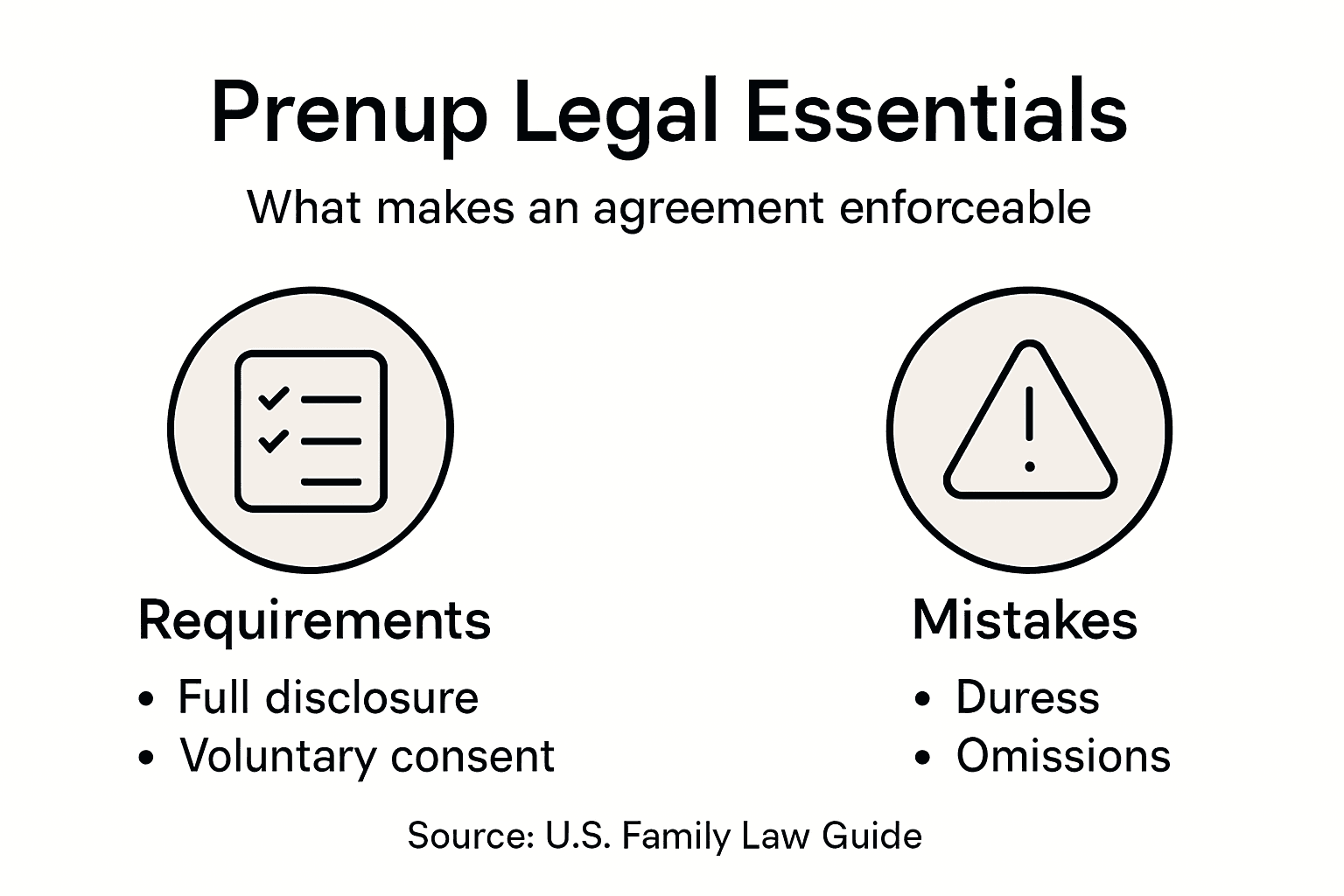
The most crucial legal requirements for a valid prenuptial agreement include complete financial transparency, voluntary participation, and fairness. Both parties must provide full disclosure of their assets, debts, and financial obligations without concealing significant financial information. The agreement must be entered into voluntarily, without any form of coercion, intimidation, or undue pressure. Courts will carefully scrutinize the document to ensure neither party was forced into signing and that the terms are fundamentally reasonable and equitable.
Key legal standards for creating an enforceable prenuptial agreement include:
- Written documentation of all financial terms
- Signed by both parties before marriage
- Complete and honest financial disclosure
- Separate legal representation recommended
- Terms cannot violate public policy
- No provisions regarding child custody or support
- Reasonable and fair economic provisions
- Compliance with state-specific legal requirements
- Executed with sufficient time before wedding
Pro tip: Consult with separate legal professionals who specialize in family law to ensure your prenuptial agreement meets all state-specific legal requirements and provides comprehensive protection for both parties.
Benefits and Drawbacks for Couples
Prenuptial agreements offer a nuanced landscape of potential advantages and challenges for engaged couples considering financial protection. Prenuptial agreement considerations reveal a complex balance between practical financial planning and emotional sensitivity. While these legal documents provide significant financial clarity, they also require careful navigation of personal and emotional dynamics.
The primary benefits of a prenuptial agreement include comprehensive financial protection, transparent asset management, and reduced potential for future conflict. By establishing clear financial boundaries before marriage, couples can protect individual assets, define debt responsibilities, and create predetermined guidelines for potential financial scenarios. These agreements allow partners to have candid discussions about financial expectations, potentially strengthening their relationship through open communication. However, the potential drawbacks include perceived emotional distance, the suggestion of mistrust, and the potential for creating tension during wedding planning.
Key benefits and potential drawbacks include:
Benefits:
- Protection of individual assets
- Clear financial expectations
- Reduced potential for future disputes
- Financial transparency
- Preservation of personal business interests
- Inheritance protection
Drawbacks:
- Potential perception of mistrust
- Emotional complexity during discussions
- Perceived lack of romantic sentiment
- Potential relationship strain
- Upfront legal costs
- Emotional vulnerability
Pro tip: Approach prenuptial agreement discussions with empathy, transparency, and mutual respect, viewing the document as a collaborative financial planning tool rather than a trust barrier.
Common Risks and Mistakes to Avoid
Navigating the complex legal landscape of prenuptial agreements requires careful attention to potential pitfalls that could compromise the document’s validity and effectiveness. Prenuptial agreement risks involve multiple nuanced considerations that can significantly impact the agreement’s legal standing and enforceability. Understanding these risks is crucial for couples seeking to create a comprehensive and legally sound financial protection strategy.
Some of the most critical mistakes that can invalidate a prenuptial agreement include signing under duress, failing to provide complete financial disclosure, and including unconscionable or overly restrictive terms. Timing is also essential, as agreements signed too close to the wedding date may be perceived as coercive. Courts carefully scrutinize these documents, looking for any indication that one party was pressured or did not have sufficient time to review and understand the agreement’s full implications.
Key risks and potential mistakes to avoid include:
Below is a summary of major risks and how couples can avoid them when drafting prenuptial agreements.
| Risk Factor | Impact on Agreement | Prevention Strategy |
|---|---|---|
| Incomplete financial disclosure | May cause invalidation | Share all financial details |
| Signing under pressure | Seen as coercion | Allow ample review time |
| Ambiguous language | Leads to disputes | Use clear, simple wording |
| Ignoring state requirements | Unenforceable agreement | Consult local legal experts |
- Signing without independent legal counsel
- Incomplete financial disclosure
- Drafting agreements too close to wedding date
- Including provisions about child custody
- Creating terms that appear extremely one-sided
- Failing to update the agreement after significant life changes
- Using overly complex or ambiguous language
- Neglecting state-specific legal requirements
- Attempting to predetermine future child support
- Including provisions that might encourage divorce
Pro tip: Schedule multiple drafting sessions with separate attorneys and allow ample time for review, ensuring both parties fully understand and voluntarily agree to all terms.
Secure Your Financial Future with a Custom Prenuptial Agreement
Facing the challenge of defining clear financial boundaries before marriage can feel overwhelming. This article highlights common concerns such as full financial disclosure, fairness, and avoiding costly mistakes—all essential in crafting an enforceable prenuptial agreement. Protecting individual assets and setting transparent expectations starts with the right legal document crafted specifically for your needs.

Take control today by accessing easy-to-use, attorney-crafted prenuptial agreement templates at forms.legal. Our platform empowers you to personalize your agreement efficiently without compromising legal rigor. Whether you want to protect business interests, manage debts, or secure inheritances, start your secure financial planning now with comprehensive forms designed to meet state requirements and reduce future conflicts. Explore how you can create your prenuptial agreement with confidence at Prenuptial Agreement Solutions.
Frequently Asked Questions
What is a prenuptial agreement?
A prenuptial agreement is a legal contract created by couples before marriage that outlines financial expectations, asset protection, and debt responsibilities during the marriage and in case of separation or divorce.
What are the key components of a prenuptial agreement?
Key components typically include provisions for defining separate versus marital property, establishing debt responsibilities, determining spousal support terms, and protecting individual business interests or inheritances.
What legal requirements must a prenuptial agreement meet to be enforceable?
A prenuptial agreement must include full financial disclosure from both parties, be entered into voluntarily, be documented in writing, signed before marriage, and comply with state-specific legal standards.
What are the advantages of creating a prenuptial agreement?
Advantages include protecting individual assets, establishing clear financial expectations, reducing the potential for future disputes, and allowing for transparent discussions about finances before marriage.