 -
-Relationship milestones often spark conversations about finances, especially for couples in the United States preparing for marriage. The topic of a prenuptial agreement can feel overwhelming or even controversial, yet these legal contracts offer much more than what popular myths suggest. By creating a clear financial framework together, couples can address asset protection, debt responsibilities, and shared expectations—transforming a difficult subject into an opportunity for honest communication and mutual confidence in their future.
Table of Contents
- Defining Prenuptial Agreements And Misconceptions
- Types Of Prenuptial Agreements And Key Features
- Legal Requirements And State Law Variations
- Financial Protections: Assets, Debts, And Business Interests
- Rights, Responsibilities, And Risks For Couples
- Common Mistakes And How To Avoid Them
Key Takeaways
| Point | Details |
|---|---|
| Importance of Prenuptial Agreements | Prenuptial agreements serve as proactive financial planning tools that establish clear expectations and protect individual assets before marriage. |
| Common Misconceptions | They are not solely for wealthy individuals; instead, they foster financial communication and mutual understanding between couples. |
| Legal and State Variations | Prenuptial agreements require strict adherence to legal standards, which can vary significantly by state, making local legal counsel essential. |
| Avoiding Common Pitfalls | Couples should prioritize full financial disclosure and seek independent legal representation to ensure the enforceability of their agreements. |
Defining Prenuptial Agreements and Misconceptions
A prenuptial agreement is a legal contract couples create before marriage to establish financial boundaries and protect individual assets. These agreements are far more nuanced than popular culture suggests, serving as strategic financial planning tools rather than divorce preparations. By clearly outlining property rights and potential financial responsibilities, prenuptial agreements help couples establish transparent expectations before entering marriage.
Contrary to common misconceptions, prenuptial agreements are not exclusively for wealthy individuals or those anticipating divorce. Instead, they represent a proactive approach to financial communication and mutual understanding. The legal document allows couples to replace default state laws regarding asset division with personalized terms that reflect their unique relationship dynamics. This flexibility ensures both parties enter marriage with a clear, mutually agreed upon financial framework.
Historically rooted in Anglo-American legal traditions, these agreements aim to protect individual rights through informed consent. Experts recommend involving independent legal counsel to prevent potential coercion and ensure both partners fully comprehend the agreement’s implications. Provisions that might unreasonably encourage divorce are typically unenforceable, underscoring the agreement’s intent to strengthen rather than undermine marital commitment.
Pro tip: Consider discussing a prenuptial agreement early in your engagement and approach the conversation as a collaborative financial planning exercise, not a confrontational negotiation.
Types of Prenuptial Agreements and Key Features
Prenuptial agreements come in various forms, each designed to address specific financial concerns and protect individual interests. Premarital agreements typically cover critical financial domains, including asset protection, debt allocation, spousal support, and inheritance rights. These legal documents allow couples to create customized financial frameworks that go beyond standard state marital property laws, providing unprecedented flexibility in managing financial expectations.
The main types of prenuptial agreements can be categorized based on their primary focus. Some agreements concentrate on protecting pre-marital assets, ensuring that property owned before marriage remains individually owned. Others emphasize establishing financial responsibilities during marriage, clarifying how joint and separate finances will be managed. A third category focuses on defining asset division mechanisms in case of potential marriage dissolution, creating clear guidelines for property distribution that supersede default legal standards.
Key features of comprehensive prenuptial agreements include full financial disclosure, specific provisions for asset classification, and clear delineation of separate versus marital property. These agreements strategically address complex financial scenarios such as business ownership, potential inheritance, debt management, and future financial obligations. Importantly, they cannot include provisions related to child custody or support, which remain under court jurisdiction. The most effective agreements balance individual protection with mutual understanding, creating a transparent financial roadmap for the relationship.
Here’s a comparison of major prenuptial agreement types and their main purposes:
| Agreement Type | Primary Focus | Typical Use Case |
|---|---|---|
| Asset Protection | Keep premarital assets separate | Protecting family wealth or inheritance |
| Debt Allocation | Assign responsibility for debts | Managing student loans or business debt |
| Marital Asset Management | Define handling of joint property | Planning finances during marriage |
| Divorce Provisions | Detail division on separation | Reducing uncertainty in divorce cases |
Pro tip: Work with separate legal counsel to ensure your prenuptial agreement is balanced, comprehensive, and reflects both partners’ financial interests.
Legal Requirements and State Law Variations
Prenuptial agreements are subject to complex legal standards that vary significantly across different states. States have unique requirements for prenuptial agreement enforceability, typically mandating that the document be voluntary, written, signed by both parties, and include comprehensive financial disclosure. While many states have adopted the Uniform Premarital Agreement Act (UPAA), which attempts to standardize legal frameworks, substantial variations remain in how courts interpret and enforce these contracts.
The legal landscape for prenuptial agreements involves several critical components that differ by jurisdiction. Most states require absolute voluntary consent, meaning neither party can be coerced or unduly pressured into signing. Financial transparency is paramount, with courts often invalidating agreements where one party failed to fully disclose their assets or debts. Some states apply stricter scrutiny, examining the agreement’s fairness at the time of signing and potentially at the time of enforcement, which introduces additional complexity for couples navigating these legal documents.
Key variations among state laws include how courts handle unconscionability, the timing of agreement execution, and specific disclosure requirements. Some jurisdictions are more lenient, focusing on the overall fairness and mutual understanding, while others apply rigid technical standards. Couples must be aware that what constitutes a valid prenuptial agreement in one state might be considered problematic in another. This geographical legal diversity underscores the importance of consulting local legal professionals who understand the specific nuanced requirements of their state’s matrimonial laws.
Pro tip: Consult with a local attorney specializing in family law to ensure your prenuptial agreement meets all state-specific legal requirements and will be enforceable in your specific jurisdiction.
Financial Protections: Assets, Debts, and Business Interests
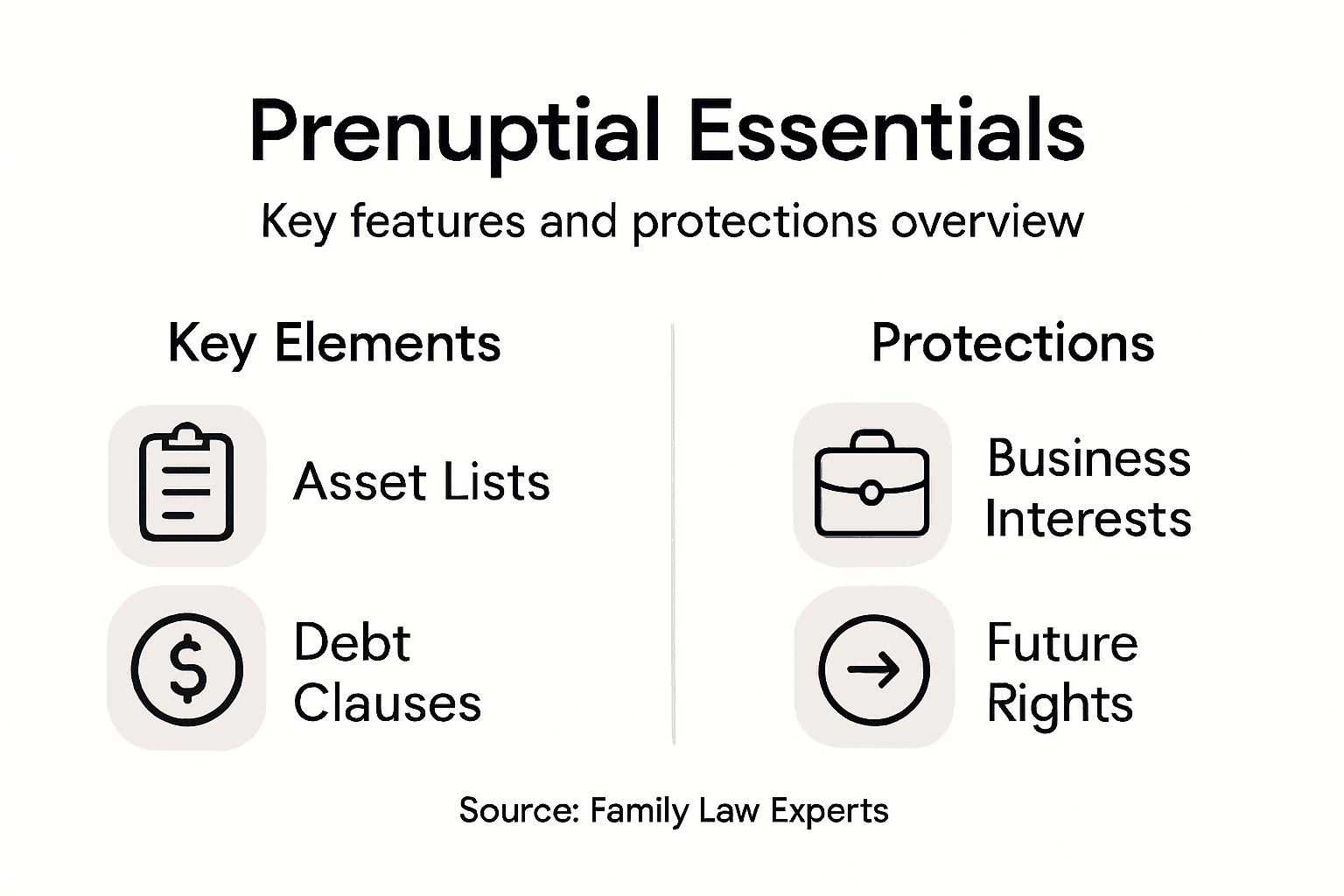
Prenuptial agreements serve as powerful legal instruments for protecting individual financial interests before and during marriage. These comprehensive documents offer strategic mechanisms for safeguarding separate assets, including real estate, investments, inheritances, and personal business ventures. By clearly defining which assets remain individually owned, couples can establish transparent financial boundaries that protect each partner’s pre-existing wealth and minimize potential conflicts during marriage or in the event of divorce.

The financial protection extends beyond asset classification to include critical debt management strategies. Prenuptial agreements can explicitly allocate responsibility for premarital and marital debts, preventing one spouse from becoming financially liable for the other’s existing obligations. This is particularly crucial for entrepreneurs, professionals with significant student loans, or individuals with complex financial histories. Business owners gain additional protection through provisions that shield their company’s ownership, preventing forced sale or division of business interests during marital dissolution.
Beyond simple asset protection, these agreements provide a nuanced financial roadmap that addresses potential economic risks and uncertainties. They can include provisions for future asset management, inheritance protections, and detailed guidelines for financial responsibilities during the marriage. The flexibility of prenuptial agreements allows couples to create customized financial frameworks that reflect their unique circumstances, personal values, and long-term economic goals. This proactive approach transforms prenuptial agreements from mere legal documents into strategic financial planning tools that promote mutual understanding and financial transparency.
Pro tip: Conduct a comprehensive financial inventory with your partner before drafting a prenuptial agreement, ensuring complete transparency and mutual understanding of each other’s financial landscape.
Rights, Responsibilities, and Risks for Couples
Prenuptial agreements establish a complex framework of rights and responsibilities that couples must carefully navigate. Legal agreements define critical financial obligations during marriage and potential separation, outlining each partner’s financial expectations and potential limitations. These documents serve as proactive tools for managing potential conflicts, allowing couples to predetermine financial boundaries and protect individual interests before marital challenges emerge.
The legal landscape of prenuptial agreements includes significant limitations and potential risks that couples must understand. While these contracts can allocate property division and financial responsibilities, they cannot address child custody or support arrangements, which remain under judicial discretion. Risks include potential court challenges if agreements are deemed unconscionable, signed under duress, or created without complete financial disclosure. This means that even carefully crafted agreements can be partially or entirely invalidated if they fail to meet strict legal standards of fairness and transparency.
Couples must approach prenuptial agreements with mutual respect and comprehensive understanding. The most effective agreements balance individual protection with shared commitment, ensuring that both parties feel heard and protected. This requires extensive communication, independent legal counsel, and a genuine commitment to financial transparency. Successful prenuptial agreements transform from potential sources of conflict into collaborative financial planning tools that strengthen marital communication and mutual trust.
Pro tip: Engage separate legal counsel and conduct a thorough, honest financial disclosure to create a prenuptial agreement that protects both parties’ interests and withstands potential legal scrutiny.
Common Mistakes and How to Avoid Them
Couples often encounter significant pitfalls when drafting prenuptial agreements, with many critical errors potentially rendering the entire document unenforceable. Common mistakes can critically compromise legal protection, including inadequate financial disclosure, signing under duress, and neglecting independent legal representation. These errors can transform what should be a protective legal document into a vulnerable agreement that courts may easily invalidate.
The most frequent mistakes stem from timing and communication breakdowns. Rushing the prenuptial agreement process close to the wedding date creates significant legal risks, as it can suggest coercion or undue pressure. Couples often make the error of discussing the agreement superficially, failing to engage in comprehensive financial transparency. This means not just listing assets, but providing complete documentation, including bank statements, investment portfolios, debt records, and potential future inheritance expectations. Full disclosure is not just recommended it is legally mandatory for creating an enforceable agreement.
Navigating the complex landscape of prenuptial agreements requires strategic planning and emotional intelligence. Successful couples approach these documents as collaborative financial planning tools rather than adversarial documents. This means engaging in honest conversations about financial expectations, potential career changes, inheritance plans, and long-term economic goals. Professional guidance becomes crucial in this process, with each partner recommended to secure independent legal counsel to ensure fair representation and minimize potential future disputes. The goal is creating a balanced agreement that protects both parties’ interests while maintaining mutual respect and trust.
The following table summarizes common mistakes and strategies to avoid them:
| Mistake | Effect on Agreement | Preventive Strategy |
|---|---|---|
| Incomplete Disclosure | Leads to invalidation | Share all financial details |
| Signing Under Pressure | Suggests coercion | Allow adequate time before wedding |
| No Independent Legal Counsel | Risk of unfair terms | Each partner hires own lawyer |
| Vague or Ambiguous Language | Disputes on enforcement | Use precise, clear legal terms |
Pro tip: Schedule multiple discussion sessions about your prenuptial agreement, spread across several months, and always involve separate legal professionals to ensure comprehensive and fair representation.
Secure Your Marriage with a Tailored Prenuptial Agreement Today
Understanding the role of prenuptial agreements in marriage security means recognizing the need for clear financial boundaries and protecting what matters most. If you want to avoid common pitfalls like incomplete disclosure or vague language, a custom prenuptial agreement can give you peace of mind and confidence as you begin your marriage. These agreements help you define asset protection, debt allocation, and marital financial responsibilities with clarity that supports mutual trust.

Take control of your financial future with easy-to-use, attorney-crafted prenuptial agreement templates available at forms.legal. Our platform simplifies the process so you can customize your agreement quickly and affordably without sacrificing legal quality. Avoid costly mistakes by preparing now with comprehensive documents designed for your unique situation. Protect your assets, outline your rights, and create a clear roadmap for your marriage today by visiting forms.legal. Start your custom prenuptial agreement now and secure the foundation of your life together.
Frequently Asked Questions
What is a prenuptial agreement?
A prenuptial agreement is a legal contract created by couples before marriage to outline financial boundaries and protect individual assets. It helps establish clear expectations regarding property rights and financial responsibilities.
Who should consider a prenuptial agreement?
Prenuptial agreements are beneficial for all couples, not just the wealthy. They promote proactive financial communication and understanding, serving to protect individual interests regardless of a couple’s financial status.
What are the key elements of a comprehensive prenuptial agreement?
Important elements include full financial disclosure, specific asset classification, and clear delineation of separate versus marital property. They should also detail debt responsibilities and provide clarity on asset division in case of separation.
What mistakes should be avoided when drafting a prenuptial agreement?
Common mistakes include inadequate financial disclosure, signing under pressure, not involving independent legal counsel, and using vague language. To avoid these pitfalls, prioritize transparency, allow sufficient time for discussion, and seek professional legal advice.