 -
-Launching a small business brings fresh excitement, but misunderstanding the protections of a Limited Liability Company can put everything at risk. Many new owners assume their personal assets are always shielded, yet courts can pierce the LLC veil if basic rules are ignored. Creating a strong LLC agreement sets the foundation for clear roles and legal safeguards, helping American entrepreneurs manage risks and avoid costly surprises.
Table of Contents
- Defining LLC Agreements And Common Misconceptions
- Key Functions Within An LLC Structure
- Legal Protections And The Operating Agreement
- Outlining Member Roles And Responsibilities
- Risks Of Operating Without A Formal Agreement
Key Takeaways
| Point | Details |
|---|---|
| Understanding LLC Agreements | LLC agreements outline critical operational components and help protect personal assets from business liabilities. |
| Importance of Legal Protections | A well-crafted operating agreement defines member roles and responsibilities, preventing conflicts and clarifying expectations. |
| Risks of Operating Without Formal Agreements | Without formal documentation, businesses face increased legal exposure and reliance on default regulations, which may not align with their intentions. |
| Consult Legal Professionals | Engage a qualified attorney to draft and review LLC agreements, ensuring they meet specific business needs and comply with state laws. |
Defining LLC Agreements and Common Misconceptions
A Limited Liability Company (LLC) represents a flexible business structure that combines critical protections for small business owners. Unlike traditional corporate models, LLCs provide a unique approach to legal and financial organization. Limited liability company structures) offer entrepreneurs significant advantages in managing business risks and personal asset protection.
At its core, an LLC agreement serves as the foundational document that establishes how a business will operate. This legal document outlines several critical components:
- Ownership percentages and member contributions
- Decision-making processes and management structures
- Profit and loss distribution methods
- Procedures for adding or removing members
- Dispute resolution mechanisms
Many small business owners misunderstand the nuanced protections offered by LLCs. Personal liability protection isn’t absolute – courts can potentially pierce the corporate veil if the business doesn’t maintain proper separation between personal and business finances. Tax classification options vary depending on how members elect to structure their LLC, which can significantly impact financial reporting and tax obligations.
Misconceptions about LLCs often lead entrepreneurs into risky legal territory. Some believe an LLC automatically shields them from all potential lawsuits or financial responsibilities. In reality, maintaining proper corporate formalities, keeping accurate records, and treating the LLC as a genuine separate entity are crucial for maintaining those protections.
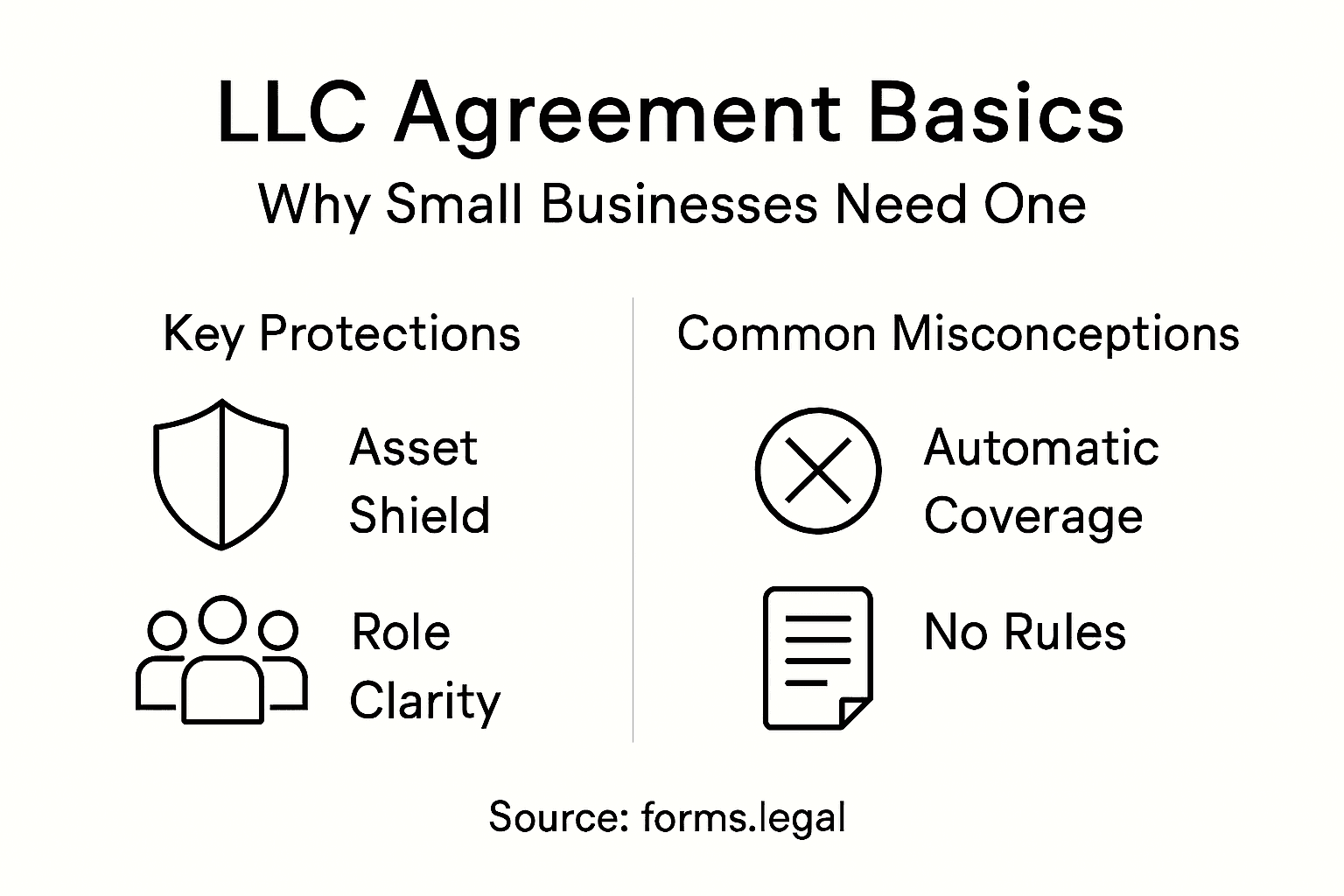
Pro tip: Always consult with a legal professional when drafting your LLC agreement to ensure comprehensive protection and compliance with state-specific regulations.
Here’s a comparison of LLC structures with other common business types:
| Business Type | Personal Liability Protection | Tax Flexibility | Maintenance Requirements |
|---|---|---|---|
| LLC | Strong if formalities kept | Multiple classifications | Moderate |
| Corporation | High with adherence | Rigid formal options | High |
| Sole Proprietorship | None, fully exposed | Simple reporting | Low |
| Partnership | Limited or none | Flow-through available | Moderate |
Key Functions Within an LLC Structure
An LLC operating agreement serves as the blueprint for a company’s internal operations, defining how the business will function on a day-to-day basis. Operating agreements comprehensively outline the fundamental rules and procedures that govern business interactions, member responsibilities, and organizational structure.
The key functions within an LLC structure typically encompass several critical areas:
- Ownership Distribution: Detailing member ownership percentages
- Management Structure: Defining decision-making processes
- Financial Arrangements: Establishing profit and loss allocation methods
- Voting Rights: Determining member voting power and influence
- Dispute Resolution: Creating mechanisms for resolving internal conflicts
Small business owners must understand that LLC agreements address multiple governance aspects beyond basic operational guidelines. These agreements can specify complex provisions such as member exit strategies, transfer of ownership conditions, and specific roles and responsibilities for each member.
Understanding the nuanced functions of an LLC agreement is crucial for protecting business interests. The document goes far beyond a simple administrative tool – it represents a legally binding contract that can prevent potential conflicts, clarify expectations, and provide a clear roadmap for business operations.

Pro tip: Consult a business attorney to customize your LLC agreement and ensure it comprehensively addresses your specific business needs and potential future scenarios.
Legal Protections and the Operating Agreement
The operating agreement represents a critical legal shield for small business owners, providing essential protections that go far beyond simple paperwork. Legal protections define member liability by establishing clear boundaries between personal and business assets, which is fundamental to maintaining the LLC’s limited liability status.
Key legal protections within an LLC operating agreement include:
- Limiting personal financial exposure
- Preventing default state rules from controlling business operations
- Clarifying member responsibilities and decision-making authority
- Establishing dispute resolution mechanisms
- Protecting individual member interests
LLC structures offer significant personal asset protection that distinguishes them from more vulnerable business formats like sole proprietorships. The operating agreement serves as a comprehensive document that not only outlines operational procedures but also reinforces the legal separation between business and personal finances.
Without a well-crafted operating agreement, small business owners risk exposing themselves to unnecessary legal vulnerabilities. Courts and regulatory agencies often look to these documents to understand the intended structure and governance of a business, making them more than just administrative tools – they are critical legal safeguards that can protect entrepreneurs from potential litigation and financial risk.
Pro tip: Have a qualified business attorney review your operating agreement to ensure it provides maximum legal protection and accurately reflects your business’s unique needs.
Outlining Member Roles and Responsibilities
In an LLC, clearly defining member roles and responsibilities is crucial for preventing potential conflicts and establishing a smooth operational framework. The operating agreement serves as the primary document that articulates each member’s specific duties, expectations, and legal obligations within the business.
Typical member roles and responsibilities often include:
- Management Responsibilities: Defining who makes strategic decisions
- Financial Contributions: Outlining initial and ongoing capital investments
- Voting Rights: Establishing decision-making power for each member
- Profit and Loss Allocation: Determining how financial outcomes are distributed
- Operational Duties: Specifying individual member tasks and expectations
Operating agreements provide critical clarity about the management structure, whether the LLC is member-managed or manager-managed. This distinction is essential because it determines how day-to-day decisions are made and who has the authority to act on behalf of the business. Some LLCs may have passive members who invest financially but do not participate in daily operations, while others require active involvement from all members.
Without a comprehensive outline of roles, small businesses risk internal disputes, misaligned expectations, and potential legal challenges. The operating agreement becomes a roadmap that guides member interactions, defines performance expectations, and provides a clear mechanism for resolving potential conflicts before they escalate.
Pro tip: Review and update member roles annually to ensure they continue to reflect the evolving needs and goals of your business.
Risks of Operating Without a Formal Agreement
Operating an LLC without a comprehensive formal agreement exposes business owners to significant legal and financial vulnerabilities. Without clear documentation, entrepreneurs leave themselves vulnerable to unpredictable legal interpretations and potential conflicts that could jeopardize their entire business structure.
The primary risks of operating without a formal LLC agreement include:
- Unintended Legal Exposure: Increased personal liability risk
- Management Uncertainty: Lack of clear decision-making protocols
- Financial Ambiguity: Undefined profit and loss distribution methods
- Default State Rules: Automatic application of potentially unfavorable regulations
- Dispute Resolution Challenges: No predefined conflict resolution mechanisms
Operating without formal documentation can lead to complex legal complications. State default rules may impose governance structures that do not align with the business owners’ intentions, potentially creating significant operational and financial challenges. This can result in unintended consequences such as unexpected tax implications, unclear member responsibilities, and potential personal asset vulnerability.
Business owners who neglect to establish a formal operating agreement essentially surrender control of their organizational structure to generic state regulations. These default provisions rarely account for the unique dynamics and specific needs of individual businesses, potentially creating unnecessary friction and legal uncertainty that could ultimately threaten the company’s stability and growth potential.
The following table summarizes possible consequences of not having a formal LLC operating agreement:
| Risk Area | Potential Impact | Example Scenario |
|---|---|---|
| Legal Liability | Personal assets at risk | Owner sued, assets targeted |
| Decision-Making | Operational confusion | Disagreements stall business |
| Profit Distribution | Disputes over financial outcomes | Members argue over payouts |
| State Control | Imposed unfavorable rules | State assigns default manager |
| Conflict Resolution | Expensive litigation more likely | No clear way to settle issues |
Pro tip: Invest in a professionally drafted LLC operating agreement early to protect your business interests and prevent potential future conflicts.
Secure Your Small Business with a Customized LLC Agreement Today
Understanding the critical role of an LLC agreement is the first step toward protecting your personal assets and defining your business operations. As highlighted, without a clear operating agreement, small business owners face risks like management confusion, personal liability, and costly disputes. This is where a well-structured legal document can safeguard your business future.

Take control now by crafting a personalized LLC operating agreement effortlessly at forms.legal. Our platform offers easy access to attorney-crafted, customizable legal forms that help you clearly define member roles, financial arrangements, and dispute resolutions without complex legal fees. Don’t wait until uncertainty threatens your business stability. Visit forms.legal to create your tailored LLC agreement and protect your business interests today.
Frequently Asked Questions
What is an LLC agreement?
An LLC agreement is a legal document that outlines the operational structure of a Limited Liability Company (LLC), detailing ownership percentages, decision-making processes, and profit distribution methods among its members.
Why do small businesses need an LLC agreement?
Small businesses need an LLC agreement to clearly define member roles, limit personal liability, establish operational guidelines, and prevent potential disputes among members, ensuring smooth business operations.
What are the risks of not having an LLC agreement?
Not having an LLC agreement increases the risk of personal liability, operational confusion, undefined financial arrangements, and reliance on state default rules, which may not reflect the owners’ intentions.
How can an operating agreement protect my LLC?
An operating agreement protects your LLC by establishing legal separations between personal and business assets, clarifying member responsibilities, and providing dispute resolution mechanisms, which help maintain the LLC’s limited liability status.