 -
-Running a small business in the United States means facing real risks every time you offer a service, host an event, or invite customers through your doors. When an accident happens, even if you have safety guidelines in place, one lawsuit could threaten your hard work. That is why understanding how a waiver is the intentional relinquishment of a recognized right or privilege matters so much. This guide shows you the essentials of waiver forms, helping you protect your business with clear legal safeguards tailored to your needs.
Table of Contents
- Definition And Core Concepts Of Waiver Forms
- Types Of Waiver Forms Used In Business
- Key Elements And Legal Requirements
- Enforceability And Limitations In U.S. Law
- Risks, Liabilities, And Common Mistakes
Key Takeaways
| Point | Details |
|---|---|
| Understanding Waivers | A waiver is a legal document where individuals give up specific legal rights, often protecting businesses from liability for inherent risks. |
| Types of Waivers | Different waivers serve various purposes, such as participant waivers for physical activities and travel waivers for transport-related risks. |
| Legal Requirements | Effective waivers must use clear language, explicitly state risks, and be signed before activities to be enforceable in court. |
| Common Mistakes | Business owners often misuse waiver formats, fail to obtain proper signatures, or do not disclose risks adequately, compromising waiver effectiveness. |
Definition and Core Concepts of Waiver Forms
A waiver form is a legal document where someone voluntarily agrees to give up a right, claim, or protection they would normally have. Think of it as signing away your ability to sue or hold someone responsible for specific types of harm or loss. At its core, a waiver is the intentional relinquishment of a recognized right or privilege. This can happen through a written document, which is the most common approach for small business owners, or sometimes through clear actions that demonstrate you’re giving up that right. When you ask customers to sign a waiver before using your services, you’re asking them to acknowledge the risks and agree not to hold you legally responsible if something goes wrong in specific ways.
For small business owners, understanding the distinction between different types of waivers matters because not all waivers work the same way. A release of liability waiver protects you from lawsuits related to accidents or injuries that occur during normal business operations. If someone signs this type of waiver and then gets injured while rock climbing at your gym or during a yoga class at your studio, they’re agreeing not to sue you for that injury. However, these waivers have limits. Courts won’t enforce a waiver that releases someone from liability for gross negligence, intentional harm, or violations of law. You also can’t use a waiver to avoid responsibility if you failed to disclose hidden dangers or operated with reckless disregard for safety. Understanding whether a release of liability waiver can actually be enforced depends heavily on how you drafted it and your specific state’s laws.
The key difference between a waiver and other legal protections lies in how it shifts responsibility. With a waiver, the person signing it is actively choosing to accept risk rather than you proving you weren’t negligent. This is powerful protection, but it only works if the waiver is specific, clearly written, and actually signed before the risky activity happens. A poorly drafted waiver or one that’s buried in fine print at the bottom of a contract page won’t hold up in court. Your waiver needs to clearly explain what risks the person is accepting and use straightforward language, not legal jargon that confuses your average customer.
Pro tip: Draft your waiver to be specific about the exact activities or risks involved, use plain language your customers can actually understand, and always have people sign before they participate in any activity, not after.
Types of Waiver Forms Used in Business
Not all waivers are created equal, and the type you need depends on what your business does and what risks your customers face. The most common form is the participant waiver, used when customers engage in physical activities or events where injury is a realistic possibility. If you run a fitness studio, sports facility, adventure park, or any business involving physical activity, you need this type. A participant waiver makes it clear that the person signing understands the risks of the activity and agrees not to hold you responsible if they get hurt. Another widely used form is the travel waiver, which protects your business if you organize trips, tours, or transport services. These waivers address risks specific to travel like accidents during transit, weather delays, or injuries that occur away from your facility. Waivers are written agreements stating that sponsors will not be liable for harm suffered by participants during activities, and they’re essential for any business operating in these spaces.
If your business involves minors, you need to understand that parental consent waivers work differently. Children cannot legally sign binding agreements in most states, so you must get signatures from their parents or legal guardians. This is critical for businesses like summer camps, youth sports programs, tutoring services, or any activity involving people under 18. The waiver must clearly explain the risks to the parent or guardian, and their signature is what makes it valid. Additionally, depending on your state, you may need specific language about parental notification of injuries or medical authorization. For businesses with employees, employee waivers present a more complicated situation. Employees may or may not need to sign waivers depending on whether the activity relates to their job duties, so check your state’s employment laws before requiring signatures.
Beyond these main categories, some businesses use specialized waivers tailored to their industry. A photo or video release waiver protects you if you want to use images of customers in marketing materials. A assumption of risk waiver is slightly different from a standard liability waiver because it focuses on inherent risks that are part of the activity itself, not risks caused by your negligence. Release of liability waivers transfer responsibility for injuries and damages from one party to another, making them powerful tools when properly drafted. The key is matching the right waiver type to your specific business activities and making sure it covers the actual risks people face when they use your services or attend your events.
Pro tip: Identify every possible activity or service your customers experience, list the specific risks involved in each one, and then use a waiver template tailored to that activity type rather than trying to use a generic waiver for everything.
Here’s an overview of common waiver types used by businesses and their main purposes:
| Waiver Type | Primary Use Case | Key Business Benefit |
|---|---|---|
| Participant Waiver | Physical activities, events | Reduces liability for injuries |
| Travel Waiver | Organized trips, transportation | Shields against travel risks |
| Parental Consent Waiver | Activities involving minors | Ensures legal parent approval |
| Employee Waiver | Job-related activities, staff events | Clarifies job risk coverage |
| Photo/Video Release | Marketing, promotion | Permits use of images/videos |
| Assumption of Risk | High-risk inherent activities | Clarifies accepted risks |
Key Elements and Legal Requirements
A waiver form cannot be a vague document that asks people to sign away all their rights. Courts will only enforce waivers that meet specific legal requirements, and small business owners need to understand what those requirements are to protect their business effectively. The first critical element is clear and specific language about the risks involved. Your waiver must explicitly state what dangers or injuries the person is accepting. If you run a rock climbing gym, your waiver should specifically mention falls, rope injuries, equipment failure, and other climbing-related hazards. A generic waiver that just says “you assume all risks” will likely fail in court because it does not clearly communicate what the person is actually agreeing to. Use plain, straightforward language that any customer can understand without needing a law degree to decode it.

The second essential element is explicit acknowledgment of risk. The person signing must clearly state that they understand the specific risks and voluntarily accept them. This goes beyond just reading the waiver. Consider including language like “I understand that rock climbing involves serious risks including falls and injuries that could result in permanent disability or death, and I voluntarily accept these risks.” The person needs to be informed before they participate, not after. This is where timing matters tremendously. A waiver signed in advance, before any activity begins, carries far more weight than one signed afterward. Additionally, key legal requirements for waivers include that research or activities involve no more than minimal risk and that obtaining full informed consent is genuinely impracticable for your specific situation.
Another vital requirement is that the waiver must not attempt to shield you from liability for gross negligence, intentional misconduct, or violations of law. Courts will void any waiver that tries to protect you from your own reckless behavior or criminal actions. You also cannot use a waiver to hide known dangers. If you know your climbing wall has faulty equipment, you cannot use a waiver to avoid responsibility for injuries caused by that equipment. The waiver must be conspicuous and properly formatted so it is not hidden in fine print or buried on page five of a contract. Use clear headings, bold text, and sufficient font size. Make sure the signature section is separate and distinct, showing that the person knowingly signed the waiver and understood its purpose. Finally, ensure your waiver complies with your specific state’s laws, as some states have stricter requirements than others for enforcing waivers.
Pro tip: Have an attorney licensed in your state review your waiver form before you use it, as state laws vary significantly on what makes a waiver enforceable, and a poorly drafted waiver offers zero protection.
Key differences between a strong and weak waiver form are summarized below:
| Criteria | Strong Waiver | Weak Waiver |
|---|---|---|
| Clarity of Language | Clear, plain wording | Legal jargon, confusing terms |
| Specific Risk Disclosure | Lists detailed risks | Uses vague, broad statements |
| Timing of Signature | Signed before activity begins | Signed after activity or during |
| Visibility in Document | Separate, prominent section | Buried in fine print or contract |
| Attorney Review | Reviewed for legal compliance | Not reviewed, lacks legal oversight |
Enforceability and Limitations in U.S. Law
Not every waiver you write will hold up in court, and understanding the boundaries of waiver enforceability is critical for protecting your business. Waivers are generally enforceable in U.S. law if voluntarily entered into and clearly expressed, but courts will examine the language, context, and fairness of the agreement before deciding whether to enforce it. The key word here is “voluntarily.” If someone feels pressured or coerced into signing your waiver, or if the waiver is so unfair that it shocks the conscience of the court, a judge may refuse to enforce it. This is why the way you present your waiver matters as much as the words it contains. Handing someone a waiver five minutes before they participate in an activity, with no time to read it, suggests a lack of true voluntariness. Courts also look at the clarity of the language. If your waiver uses legal jargon that ordinary people cannot understand, a court may rule that the signer did not truly comprehend what they were agreeing to.
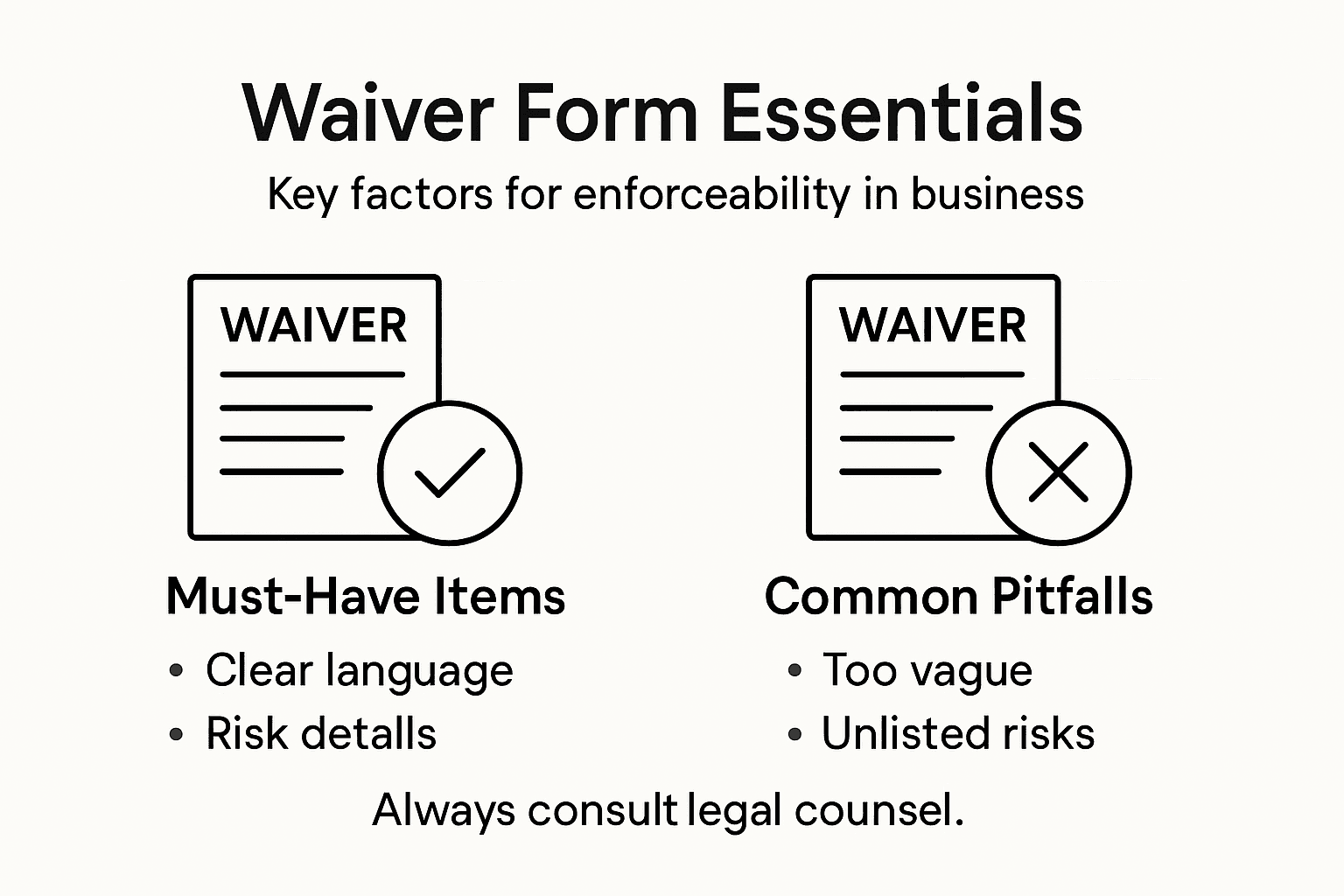
The biggest limitation on waiver enforceability is that you absolutely cannot use a waiver to escape liability for gross negligence or willful misconduct. This distinction matters tremendously. Ordinary negligence means you made a reasonable mistake or failed to take basic precautions. Gross negligence means you acted with reckless disregard for safety, knowing that your actions could cause serious harm. If a customer is injured because you failed to maintain basic safety equipment, that is ordinary negligence and a waiver might protect you. But if you know your equipment is dangerous and you do not warn customers or take action to fix it, that is gross negligence and no waiver will shield you. Similarly, if you intentionally harm someone or intentionally conceal a known danger, no waiver prevents them from suing. Courts view these limitations as public policy requirements because allowing waivers to cover gross negligence or intentional harm would encourage businesses to operate recklessly.
Another important consideration involves state law variations. Some states are more waiver friendly than others, and a few states refuse to enforce waivers in certain industries like childcare or transportation. Additionally, some states require specific statutory language in waivers, particularly for certain activities. What works in California might not be enforceable in New York. Federal law also plays a role in certain contexts. The Federal Arbitration Act allows businesses to include waiver clauses that prevent customers from filing class action lawsuits, directing them toward arbitration instead, though courts will strike down such clauses if they are unconscionable or unfairly one sided. This creates a complex patchwork where a well drafted waiver in one state might be completely unenforceable in another.
Pro tip: Consult with an attorney licensed in your specific state to ensure your waiver meets that state’s enforceability standards, as federal and state law requirements vary significantly and what works for a competitor in another state may not protect you.
Risks, Liabilities, and Common Mistakes
Many small business owners believe that once they have a signed waiver, they are completely protected from liability. This misconception is dangerous and has led countless business owners to discover, too late, that their waivers are worthless. The reality is that waivers are one piece of a comprehensive risk management strategy, not a legal shield that eliminates all responsibility. You still bear the responsibility for maintaining a safe environment, properly training your staff, and taking reasonable precautions to prevent injuries. A waiver does not excuse you from maintaining your equipment, addressing known hazards, or following applicable safety regulations. If you know your climbing wall has loose bolts and someone gets injured, the waiver will not protect you because you failed to maintain a safe environment. The waiver’s purpose is to protect you from liability for inherent risks that cannot be eliminated, not to excuse your negligence.
Common mistakes undermine waiver effectiveness in ways that surprise many small business owners. One major error is using the wrong waiver format for your specific activity or state. Common mistakes include using incorrect waiver formats, failure to obtain signatures properly, and allowing minors to sign waivers. Another critical mistake is not obtaining signatures at all or obtaining them improperly. If someone signs your waiver digitally without proper identity verification, or if they sign it after the activity has begun, you have created serious enforceability problems. Many business owners also fail to give people adequate time to read and understand the waiver before signing. Rushing someone through a signature defeats the “voluntariness” requirement that courts look for. Additionally, storing waivers carelessly creates problems if you later need to produce them as evidence. Losing signed waivers or keeping them in disorganized files means you cannot prove someone actually signed an agreement if a lawsuit arises.
Another significant risk involves inadequate risk disclosure. You must explicitly describe the specific dangers involved in your activities. Inadequate risk disclosure and improper administration are common errors that leave organizations vulnerable to liability claims. Simply listing generic risks like “accidents may occur” is not enough. Your waiver should detail falls, equipment failure, muscle strains, dehydration, or whatever specific hazards your activity presents. Many business owners also make the mistake of thinking a waiver handles everything. Waivers work best when combined with proper staff training, regular equipment maintenance, clear safety rules, and documented risk assessments. You need a system where you track maintenance records, document any incidents that occur, and keep training records for your staff. This documentation becomes crucial evidence if you ever end up in court defending your business.
Pro tip: Create a simple filing system for signed waivers, organize them by date and participant name, keep them for at least seven years, and conduct an annual review of your waiver language with an attorney to ensure it matches your current activities and state law.
Protect Your Business With Strong, Customizable Waiver Forms
Understanding what a waiver form is and why it matters is the first crucial step to shielding your business from costly legal risks. This article reveals common pitfalls in waiver language and enforcement, along with the key elements needed for a waiver to hold up in court. Don’t leave your liability protection to chance because a vague or improperly timed waiver can leave you open to lawsuits and financial loss. Whether you need a participant waiver, parental consent waiver, or a specialized release, having a clearly written, legally sound document is essential.

Take control today by creating your own tailored waiver form with the trusted resources at forms.legal. Our intuitive platform offers attorney-crafted templates that you can customize quickly and download instantly. Avoid common mistakes like confusing legal jargon or missing risk disclosures by using our user-friendly waiver templates designed specifically for your industry. Protect your business, ensure legal compliance, and gain peace of mind now. Visit forms.legal and start customizing your waiver form with confidence. Get ahead of risks before they happen and safeguard your future.
Frequently Asked Questions
What is a waiver form?
A waiver form is a legal document where a person voluntarily agrees to relinquish a right, claim, or protection they would normally have, often to acknowledge risks associated with an activity.
Why do businesses use waiver forms?
Businesses use waiver forms to protect themselves from liability by having customers acknowledge potential risks and agree not to hold the business responsible in case of accidents or injuries during activities.
What elements should be included in a waiver form to make it enforceable?
A waiver form should include clear and specific language about the risks involved, an explicit acknowledgment of risk by the signer, and must not attempt to shield the business from liability for gross negligence or intentional misconduct.
How can I ensure my waiver form is legally binding?
To ensure your waiver form is legally binding, draft it with clear, straightforward language, have it signed before any activity starts, avoid hiding it in fine print, and consider having a legal professional review it to comply with state laws.