 -
-Launching a joint business venture can seem straightforward, but misunderstandings around roles, finances, and decision-making quickly test any collaboration. For American small business owners, the need for a solid partnership agreement is more than paperwork—it is a blueprint that protects interests and prevents costly legal trouble. This article offers a practical overview of what partnership agreements are, their core elements, and why clear documentation is vital for sustaining successful partnerships.
Table of Contents
- Defining Partnership Agreements In Business
- Types Of Partnerships And Agreement Variations
- Key Elements In A Partnership Contract
- Legal Protection And Risk Reduction Benefits
- Common Pitfalls Without A Written Agreement
Key Takeaways
| Point | Details |
|---|---|
| Importance of Partnership Agreements | A partnership agreement outlines each partner’s rights, responsibilities, and operational expectations, preventing potential conflicts. |
| Types of Partnerships | Different partnership structures, such as General Partnerships, Limited Partnerships, and Joint Ventures, cater to various operational needs and risk management strategies. |
| Legal Protection Benefits | Partnership agreements provide essential legal protections by defining roles, liabilities, and dispute resolution mechanisms, safeguarding against risks. |
| Risks of Unwritten Agreements | Operating without a written agreement can lead to significant financial and legal risks, including undefined profit distribution and uncontrolled financial exposure. |
Defining Partnership Agreements in Business
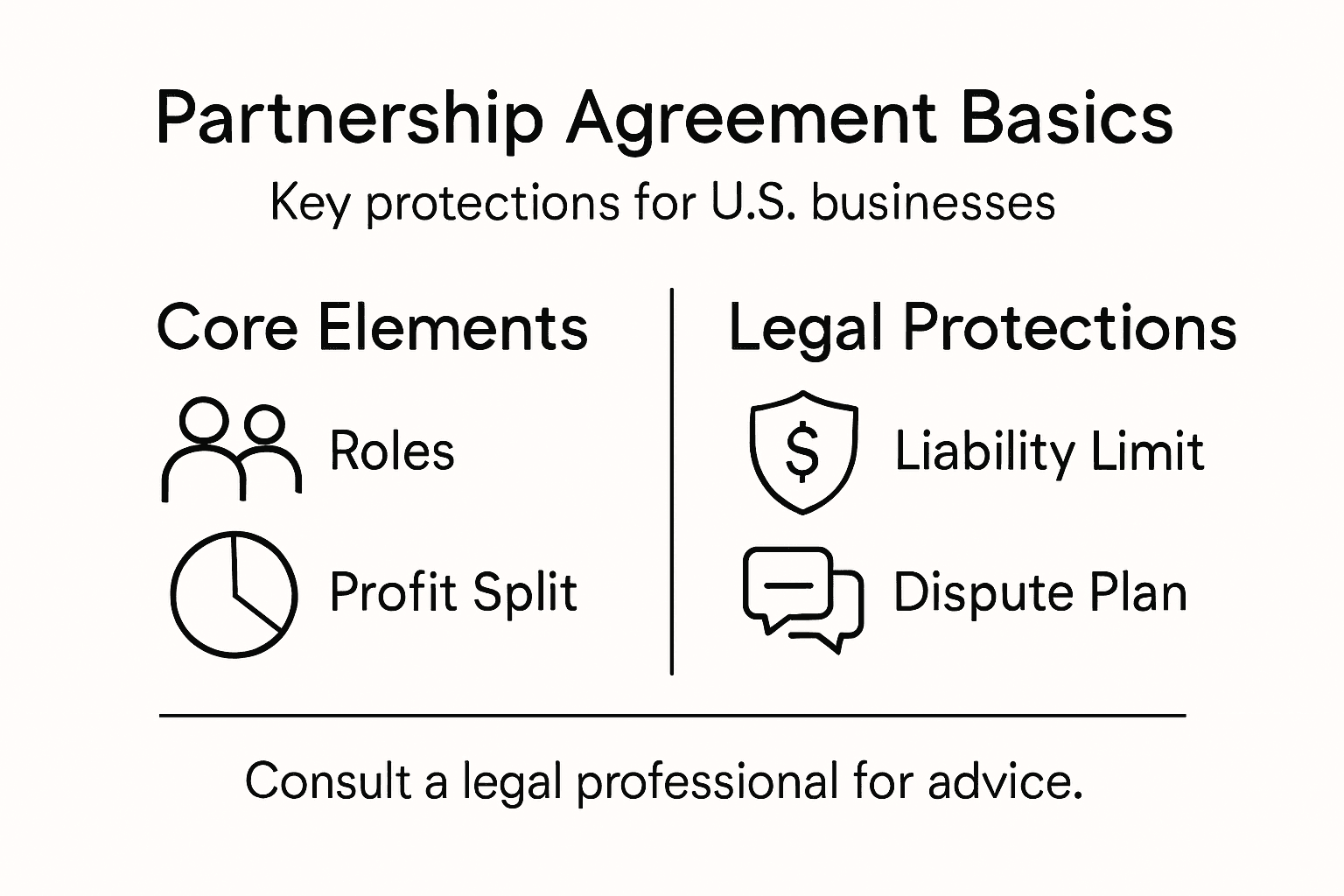
A partnership agreement is a crucial legal document that establishes the fundamental ground rules for business relationships between two or more individuals collaborating to generate profit. Partnership agreements serve as comprehensive blueprints that outline each partner’s rights, responsibilities, and operational expectations.
These legally binding contracts typically include several key components that protect all parties involved:
- Percentage of ownership for each partner
- Initial financial contributions
- Profit and loss distribution mechanisms
- Decision-making protocols
- Dispute resolution procedures
- Provisions for adding or removing partners
Unlike formal corporate structures, partnerships can form relatively simply. According to legal definitions, partnerships emerge when individuals voluntarily associate as co-owners with the intent of generating business profits. This means a formal written agreement isn’t always legally required—but creating one remains strongly recommended.
Partnership agreements provide critical protections by establishing clear expectations and preventing potential conflicts. They define each partner’s role, financial stakes, and operational responsibilities, creating a transparent framework that reduces misunderstandings and potential legal disputes.
Pro tip: Have an experienced business attorney review your partnership agreement to ensure all critical elements are comprehensively addressed and your interests are fully protected.
Types of Partnerships and Agreement Variations
Businesses have multiple partnership structures available, each designed to address specific operational needs and risk management strategies. Partnership types vary based on collaboration complexity and each offers unique advantages for different business scenarios.
The primary partnership variations include:
- General Partnerships: Default structure where all partners share equal management responsibilities and personal liability
- Limited Partnerships: Includes both general and limited partners, with varying levels of financial involvement and legal protection
- Limited Liability Partnerships (LLPs): Provides personal liability protection while maintaining operational flexibility
- Strategic Alliances: Collaborative arrangements focusing on market expansion and shared innovation
- Joint Ventures: Project-specific partnerships with defined timeframes and shared risks
Each partnership type requires careful consideration of specific collaboration frameworks and organizational goals. The chosen structure significantly impacts financial responsibilities, decision-making processes, and potential legal exposures.
Beyond basic classifications, partnership agreements can be further customized to address unique business requirements. Factors like ownership percentages, profit distribution mechanisms, dispute resolution protocols, and exit strategies can be tailored to match the specific dynamics of the partnering organizations.
Here’s a quick comparison of common partnership types and their business impact:
| Type of Partnership | Liability Exposure | Operational Flexibility | Typical Uses |
|---|---|---|---|
| General Partnership | High for all partners | Moderate flexibility | Small businesses, family ventures |
| Limited Partnership | Limited for some partners | Low for limited partners | Passive investment scenarios |
| LLP | Limited for all partners | High flexibility | Professional firms, consultancies |
| Joint Venture | Shared by all parties | Flexible, project-based | One-time projects, market testing |
| Strategic Alliance | Depends on agreement | High flexibility | Innovation, expansion partnerships |
Pro tip: Consult a business attorney to determine the most appropriate partnership structure for your specific operational goals and risk tolerance.
Key Elements in a Partnership Contract
Crafting a comprehensive partnership contract requires careful consideration of multiple critical components that protect all parties’ interests. Partnership agreements must address key collaboration elements to ensure smooth business operations and minimize potential conflicts.
The fundamental elements of a robust partnership contract include:
- Shared Vision and Goals: Clear definition of partnership objectives
- Partner Roles and Responsibilities: Detailed description of each partner’s specific duties
- Financial Contributions: Exact breakdown of initial and ongoing financial investments
- Profit and Loss Distribution: Precise mechanism for sharing financial outcomes
- Decision-Making Protocols: Structured approach to resolving business decisions
- Dispute Resolution Mechanisms: Clear process for addressing potential conflicts
- Exit Strategies: Defined procedures for partner departure or business dissolution
Effective partnership agreements require continuous review and adaptation to remain relevant and responsive to changing business dynamics. The contract should provide flexibility while maintaining clear boundaries and expectations for all involved parties.

Beyond basic structural elements, successful partnership contracts demand transparency, mutual understanding, and a commitment to open communication. Partners must be willing to invest time in developing a comprehensive agreement that anticipates potential challenges and provides practical solutions for navigating complex business relationships.
Pro tip: Have a qualified business attorney review your partnership contract to ensure all critical legal protections and nuanced business considerations are thoroughly addressed.
Legal Protection and Risk Reduction Benefits
Partnership agreements serve as critical legal shields that protect businesses from potential financial and operational risks. Partnership agreements provide essential legal protections by establishing clear operational guidelines and defining each partner’s responsibilities and potential liabilities.
The key legal protection mechanisms include:
- Liability Limitation: Reducing personal financial exposure
- Dispute Resolution Framework: Predefined processes for conflict management
- Financial Accountability: Clear definitions of financial contributions and responsibilities
- Operational Boundaries: Establishing specific roles and decision-making protocols
- Risk Mitigation: Mechanisms for addressing potential business challenges
Limited Liability Partnerships (LLPs) offer specific risk reduction strategies that protect individual partners from unauthorized actions or financial liabilities caused by other partners. These structures create a legal buffer that prevents one partner’s mistakes from devastating the entire business.
Beyond basic protection, a well-crafted partnership agreement acts as a proactive legal document that anticipates potential challenges. It provides a comprehensive framework for addressing complex business scenarios, reducing the likelihood of costly legal disputes and ensuring all partners understand their rights, responsibilities, and potential risks.
Pro tip: Invest in a professional legal review of your partnership agreement to identify and address potential vulnerabilities before they become significant issues.
The following table summarizes how legal protection features impact partnership success:
| Legal Feature | Risk Addressed | Resulting Benefit |
|---|---|---|
| Liability Limitation | Prevents personal asset loss | Safeguards individual finances |
| Dispute Resolution | Reduces legal uncertainty | Maintains business continuity |
| Operational Boundaries | Prevents role confusion | Increases efficiency |
| Financial Accountability | Stops ambiguous spending | Promotes trust and stability |
Common Pitfalls Without a Written Agreement
Operating without a formal partnership agreement can expose businesses to significant legal and financial risks. Default state laws often create unintended consequences that can derail business operations and create unexpected financial liabilities for partners.
The most critical pitfalls in unwritten partnerships include:
- Uncontrolled Financial Exposure: Partners becoming liable for each other’s actions
- Undefined Profit Distribution: Automatic equal sharing regardless of individual contributions
- Unlimited Decision-Making Power: Any partner can potentially bind the entire partnership to contracts
- Unclear Role Boundaries: Lack of defined responsibilities and expectations
- Complex Partner Departure Processes: No predefined exit strategies
Partnerships without written agreements risk serious operational breakdowns that can damage trust, reduce business efficiency, and create long-lasting conflicts. These informal arrangements leave partners vulnerable to misunderstandings, legal disputes, and potential financial catastrophes.
Without a comprehensive written agreement, partners essentially surrender control to default legal frameworks that may not reflect their original intentions or business goals. This can result in unexpected financial obligations, unpredictable dispute resolution processes, and potential complete business dissolution.
Pro tip: Draft a written partnership agreement before launching your business, even if you’re partnering with close friends or family members.
Secure Your Business Partnership with Clear Legal Agreements
Navigating the complexities of partnership agreements can feel overwhelming. The risks of undefined roles, financial exposure, and dispute confusion threaten the success of your business collaboration. This article reveals why crafting a detailed partnership contract is essential for reducing liabilities and protecting everyone involved. Terms like liability limitation, dispute resolution, and exit strategies are not just legal jargon but critical shields for your business future.

Ready to take control and prevent costly misunderstandings with a professionally crafted partnership agreement? Explore our extensive collection of attorney-crafted legal templates at forms.legal. Whether you need a general partnership or limited liability partnership agreement, our customizable documents simplify this crucial process. Don’t wait for problems to arise. Visit forms.legal today and create your partnership agreement quickly and affordably to protect your investment and peace of mind.
Frequently Asked Questions
What is a partnership agreement?
A partnership agreement is a legal document that outlines the rights, responsibilities, and operational expectations of partners in a business venture. It serves as a framework for collaboration and helps prevent misunderstandings and disputes.
Why is it important to have a written partnership agreement?
A written partnership agreement is crucial because it establishes clear guidelines for profit distribution, decision-making processes, and dispute resolution. Without one, partners may face significant risks and unintended consequences from default legal frameworks.
What are the main components of a partnership agreement?
Key components of a partnership agreement typically include ownership percentages, financial contributions, profit and loss distribution mechanisms, decision-making protocols, and dispute resolution procedures.
How can a partnership agreement protect my business?
A partnership agreement protects your business by limiting liability, providing a framework for dispute resolution, and establishing clear operational boundaries. This reduces the risk of financial exposure and helps maintain business continuity.