 -
-More than half of American couples admit they worry about money before marriage. Financial planning can bring peace of mind but hiring attorneys often means spending thousands. Creating a transparent, customizable prenuptial agreement empowers engaged couples to protect their future together without breaking the bank. Discover practical steps to take control of your shared financial security and build a foundation of trust right from the start.
Table of Contents
- Step 1: Gather Financial Information Together
- Step 2: Discuss Terms and Priorities as a Couple
- Step 3: Customize a Prenuptial Agreement Template
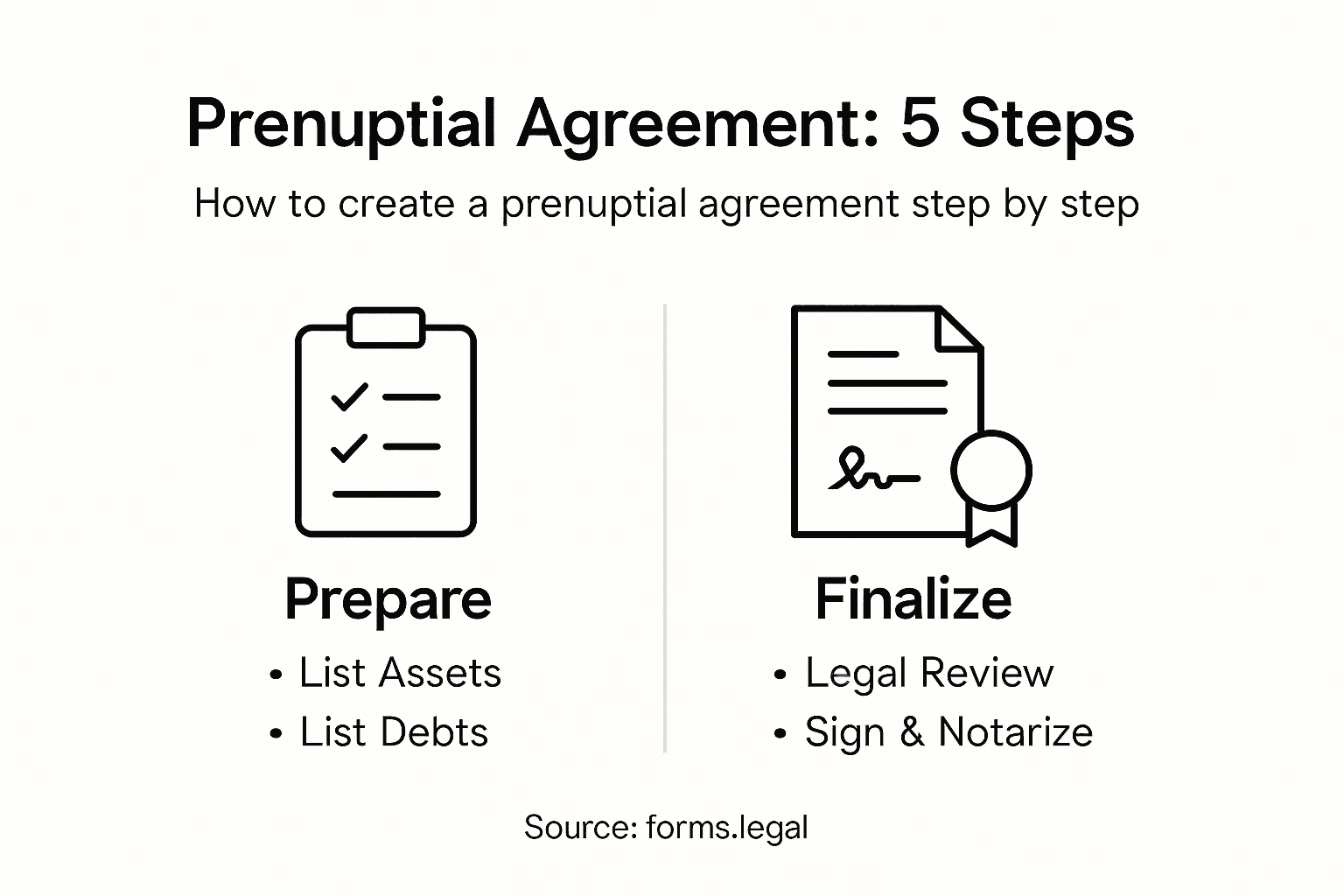
- Step 4: Review and Revise the Draft with Legal Guidance
- Step 5: Sign and Notarize the Prenuptial Agreement
Quick Summary
| Key Point | Explanation |
|---|---|
| 1. Gather Financial Information | Compile a thorough financial profile with detailed documentation on assets and liabilities from both partners. |
| 2. Have Open Discussions | Engage in respectful conversations about financial expectations and responsibilities to establish mutual understanding. |
| 3. Customize the Agreement | Tailor a standard prenup template to reflect your unique financial situation and mutual agreements effectively. |
| 4. Legal Review is Essential | Hire separate attorneys to ensure the agreement is fair, accurate, and legally enforceable through professional review. |
| 5. Sign and Notarize Properly | Both partners must sign in the presence of a notary to authenticate the agreement and enhance its legal validity. |
Step 1: Gather Financial Information Together
In this step, you will compile a comprehensive financial profile that forms the backbone of your prenuptial agreement. Think of this as creating a financial snapshot that provides total transparency between you and your partner.
Starting the financial information gathering process requires thoroughness and honesty. You and your partner will need to collect detailed documentation about all assets and liabilities. This means pulling together bank statements, retirement account records, investment portfolios, real estate holdings, vehicle titles, and any business ownership documents. Comprehensive financial disclosure is critical to creating a valid prenuptial agreement that can withstand potential legal scrutiny.
While collecting documents, be prepared to discuss everything from checking and savings accounts to student loans, credit card debts, and anticipated inheritances. Transparency is key here. The goal is not to judge each other’s financial history but to create a clear, mutual understanding. Remember that hiding financial information can invalidate the entire prenuptial agreement, so commit to total openness.
Pro tip: Create a shared digital folder where both partners can upload and review financial documents securely to ensure complete transparency and easy access.
Here is a summary of key documents typically needed during financial information gathering for a prenuptial agreement:
| Document Type | Purpose | Example Contents |
|---|---|---|
| Bank Statements | Verify liquid assets | Checking, savings account info |
| Real Estate Records | Confirm property ownership | Title deeds, mortgage documents |
| Investment Portfolios | Assess investments | Stocks, bonds, mutual funds |
| Debt Statements | Show outstanding liabilities | Student loans, credit card debt |
| Business Ownership | Clarify business interests | LLC papers, partnership shares |
| Retirement Accounts | Document future savings | 401(k), IRA, pension statements |
Step 2: Discuss Terms and Priorities as a Couple
In this crucial step, you will engage in an open and honest conversation about your financial expectations, goals, and potential concerns for your upcoming marriage. This discussion forms the foundation of a meaningful prenuptial agreement that reflects both partners’ needs and perspectives.
Approach this conversation with mutual respect and transparency. Customizing your prenuptial agreement requires understanding each other’s financial background and future aspirations. Start by discussing what assets you each bring into the marriage, including personal savings, real estate, investments, and potential inheritances. Be prepared to explore how you want to manage shared and individual finances during your marriage.
Focus on establishing clear financial terms and responsibilities that protect both partners. This might include defining how you’ll handle household expenses, manage existing debts, protect individual business interests, and outline expectations for future asset appreciation. Remember that a prenup is not about mistrust but about creating a mutually understood financial framework that provides security and clarity for both partners.
Pro tip: Consider scheduling multiple conversation sessions to discuss financial matters, allowing each partner time to process information and reflect between discussions.
Step 3: Customize a Prenuptial Agreement Template
This step involves transforming a standard legal template into a personalized document that accurately reflects your unique financial situation and mutual agreements. Your goal is to create a comprehensive agreement that protects both partners’ interests while remaining legally enforceable.

Drafting a customized prenuptial agreement requires careful attention to specific financial details and potential future scenarios. Begin by reviewing the template sections related to property classification, determining which assets will remain separate and which might be considered marital property. Pay special attention to how you want to handle existing assets, potential inheritances, business interests, and future income streams. Each section should be tailored to address your specific financial landscape, ensuring that the agreement provides clear guidelines for asset management during marriage and potential division in case of divorce.
Ensure that your agreement complies with legal standards by using precise language and avoiding any ambiguous terms. Include comprehensive financial disclosures, outline spousal support provisions, and address debt allocation strategies. The more specific and transparent you are during this customization process, the more likely your agreement will be considered fair and enforceable by legal standards.
Pro tip: Consider working with a legal professional to review your customized template and ensure it meets all legal requirements specific to your state.
Step 4: Review and Revise the Draft with Legal Guidance
This critical step involves having professional legal experts thoroughly examine your prenuptial agreement to ensure its accuracy, fairness, and legal enforceability. Your goal is to validate the document and protect both partners’ interests through expert review and potential strategic revisions.
Legal review of prenuptial agreements requires each partner to obtain independent legal counsel. This means hiring separate attorneys who can provide unbiased advice and verify that the agreement meets all legal standards. Your respective lawyers will scrutinize every clause, checking for potential areas of ambiguity, ensuring full financial disclosure, and confirming that the terms are reasonable and balanced. They will examine how assets are classified, verify spousal support provisions, and assess debt allocation strategies to confirm the agreement protects both parties.
During the review process, be prepared for potential recommended revisions. Attorneys will examine the agreement to confirm it complies with state laws and does not contain any unconscionable terms. They might suggest language modifications, additional clauses, or restructuring certain sections to enhance legal clarity and protection. This collaborative process helps create a robust document that stands a stronger chance of being upheld in court, should the need ever arise.
Pro tip: Schedule a joint meeting with both attorneys to discuss proposed revisions simultaneously, which can help streamline the review process and maintain transparency.
Step 5: Sign and Notarize the Prenuptial Agreement
This final step transforms your carefully drafted prenuptial agreement from a legal document into an officially recognized contract. Your goal is to ensure the agreement is properly executed with legal authenticity and mutual consent.
Notarization validates the prenuptial agreement by providing an official confirmation of both parties’ voluntary participation. When signing, both partners must be present with a licensed notary public who will verify each person’s identity and witness the signatures. This process involves more than simply adding signatures the document requires each party to demonstrate they are signing willingly and with full understanding. The notary will typically ask for government issued photo identification and may record additional details like thumbprints to further authenticate the document.
Notarization helps prevent future signature disputes by creating an official record of the signing. While not every state legally mandates notarization, having the document notarized significantly strengthens its enforceability. The notary serves as an impartial third party who confirms that both individuals understand the agreement and are signing without coercion. This additional layer of verification can be crucial if the prenuptial agreement is ever challenged in court.
Pro tip: Bring multiple forms of government identification and schedule enough time for the notarization process to ensure a smooth, unhurried signing experience.
The prenuptial agreement process involves several steps, each with a distinct focus and legal effect:
| Step | Primary Focus | Legal Effect |
|---|---|---|
| Gather Financial Info | Collect complete disclosures | Lays foundation for validity |
| Discuss Terms | Set mutual goals and priorities | Ensures fairness |
| Customize Agreement | Tailor legal document | Reflects unique situation |
| Legal Review | Verify with independent advice | Ensures enforceability |
| Sign and Notarize | Authenticate signatures | Makes document official |
Secure Your Future With a Personalized Prenuptial Agreement Today
Creating a prenuptial agreement can feel overwhelming as you sort through financial disclosures, discuss terms, and customize legal documents that truly reflect both partners’ needs. The article highlights challenges like gathering detailed asset information, ensuring transparency, and making your agreement legally enforceable. If you want to simplify these complex steps and avoid costly legal missteps, you need a straightforward solution that lets you take control without waiting on attorneys.

Take charge of your financial clarity by starting your prenuptial agreement with forms.legal. Our platform offers attorney-crafted, customizable prenup templates designed to guide you through each essential section like asset protection and debt allocation. You can easily tailor your agreement to fit your unique situation while ensuring full legal compliance. Don’t wait until the last minute. Protect your interests and create peace of mind by visiting forms.legal now and get started on your personalized prenup with confidence.
Frequently Asked Questions
What financial information do I need to gather for a prenuptial agreement?
To create a prenuptial agreement, you need to collect comprehensive financial details, including bank statements, real estate records, investment portfolios, and information about any debts. Start by organizing all relevant documents in a shared digital folder to ensure transparency with your partner.
How can we discuss terms and priorities for our prenuptial agreement?
Engage in an open conversation with your partner about financial expectations and concerns regarding your marriage. Schedule multiple discussions to focus on individual assets, shared financial responsibilities, and any future goals you wish to address in the agreement.
How do I customize a prenuptial agreement template?
Begin by reviewing a standard prenuptial agreement template and modify it to fit your unique financial situation and mutual agreements. Tailor sections regarding asset classification, spousal support, and debt allocation to reflect your specific circumstances clearly and accurately.
Why is it important to have legal guidance while drafting a prenuptial agreement?
Having a legal professional review your prenuptial agreement is crucial to ensure that the document meets all legal standards and is fair to both partners. Schedule a meeting with separate attorneys to discuss the agreement’s clauses and make necessary revisions for accuracy.
What steps should I take to notarize my prenuptial agreement?
To notarize your prenuptial agreement, both partners must sign the document in the presence of a licensed notary public. Bring the required identification and schedule enough time for the notarization process to ensure a smooth and efficient signing experience.
Recommended
- Iowa Prenuptial Agreement – Prenuptial Agreement without Lawyers
- Is prenuptial agreement a good idea? California Prenuptial Agreement
- Florida Prenuptial Agreement – Why use prenuptial agreement?
- Delaware Prenuptial Agreement – What does prenuptial agreement cover?
- 7 consejos esenciales para fortalecer el matrimonio juntos – reKindle | The Relationship Assistant AI