 -
-Small business owners in the United States often find themselves facing legal paperwork that feels overwhelming. When it comes to affidavits, the difference between a simple written statement and a sworn legal document can mean everything for protecting your interests. Understanding these legally binding declarations and avoiding common misconceptions can help you create accurate, court-ready documentation without hefty attorney costs. This guide empowers you with clear facts so you can confidently manage affidavits for your business.
Table of Contents
- Affidavit Definition And Common Misconceptions
- Main Types Of Affidavits Used In Business
- Essential Requirements For A Valid Affidavit
- Legal Standing And Real-World Business Uses
- Risks, Costs, And Frequent Filing Mistakes
Key Takeaways
| Point | Details |
|---|---|
| Affidavit Importance | Affidavits are legally binding documents that require specific formatting and notarization to be valid in court. |
| Common Misunderstandings | Many small business owners confuse affidavits with casual written statements, leading to potential legal complications. |
| Legal Requirements | Essential components include personal knowledge, proper structure, and notarization to ensure legal integrity. |
| Filing Mistakes | Common errors like signing before notarization can invalidate affidavits and lead to significant legal issues. |
Affidavit Definition and Common Misconceptions
An affidavit is a legally binding document that serves as a sworn statement of facts, typically signed in the presence of an authorized official like a notary public. Sworn statements have specific legal implications that small business owners should understand to protect their interests and maintain legal credibility.
Unlike casual written statements, affidavits carry significant legal weight because they are:
- Signed under oath
- Legally binding
- Admissible in court proceedings
- Potentially subject to perjury charges if intentionally false
Many small business owners misunderstand affidavits, often confusing them with standard written declarations. Key differences include the formal verification process and potential legal consequences. An affidavit requires the person making the statement (called the affiant) to confirm the document’s truthfulness in front of an authorized witness.
Common misconceptions about affidavits include believing they are:
- Interchangeable with regular written statements
- Always admissible in all legal contexts
- Simple to create without specific formatting requirements
- Guaranteed to be accepted by courts without scrutiny
Pro tip: Always consult with a legal professional to ensure your affidavit meets specific jurisdictional requirements and serves your intended purpose.
Main Types of Affidavits Used in Business
Small businesses encounter various types of affidavits that serve critical legal and operational purposes. Affidavits help verify essential business facts without requiring extensive court testimony, making them valuable tools for documenting important transactions and claims.
The most common types of business affidavits include:
-
Financial Affidavits
- Verify financial stability
- Document income and assets
- Support loan applications
- Confirm creditworthiness
-
Identity Verification Affidavits
- Confirm personal or business identity
- Validate ownership of assets
- Support legal name changes
- Establish business credentials
-
Property and Transaction Affidavits
- Document property ownership
- Confirm business asset transfers
- Resolve property disputes
- Support real estate transactions
Each type of affidavit serves a specific purpose in protecting business interests and providing legally recognized documentation. Small business owners must understand the nuanced requirements for different affidavit types to ensure they accurately represent their business’s legal needs.
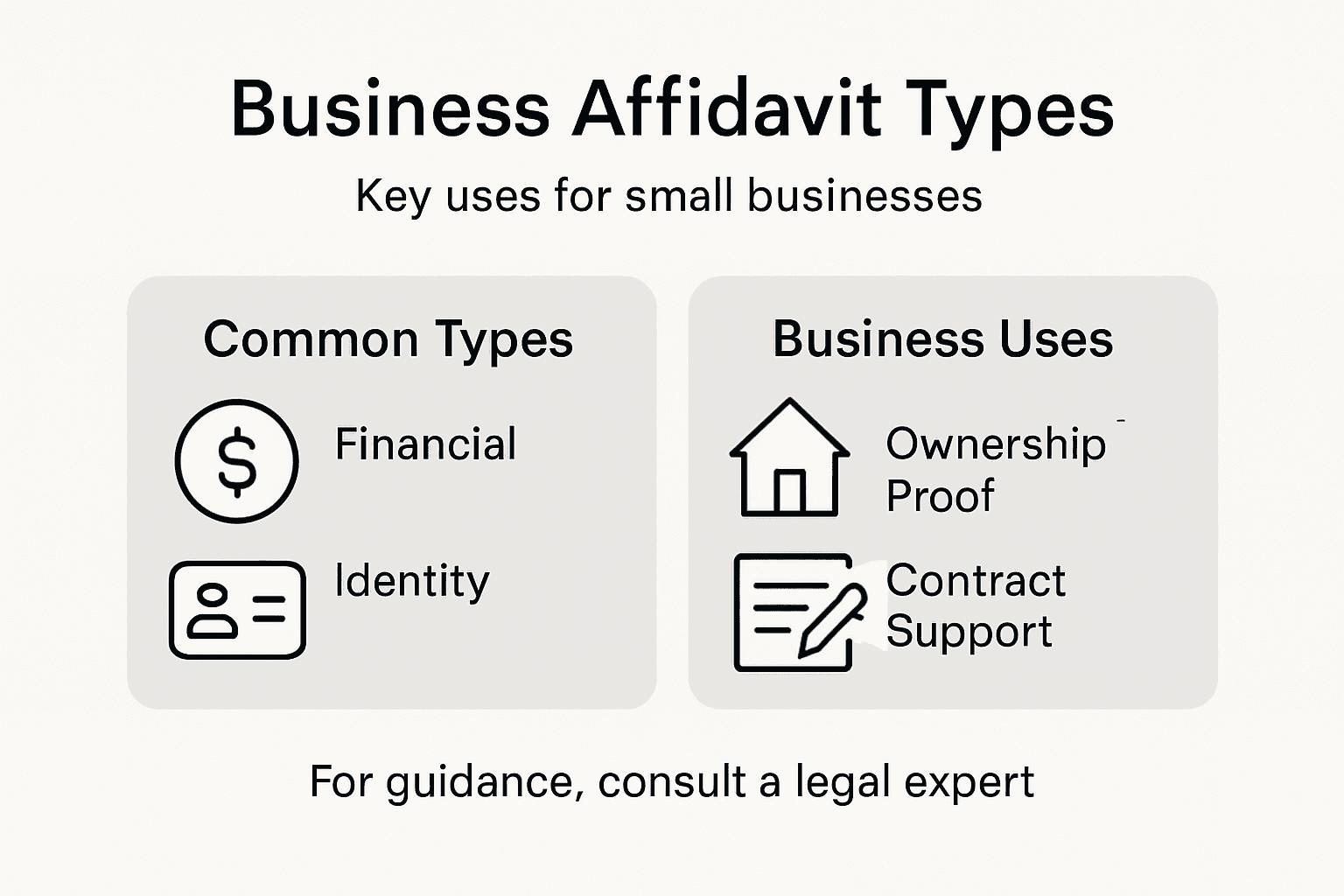
Here’s a summary comparing affidavit types and their primary business uses:
| Affidavit Type | Typical Purpose | Common Business Scenario |
|---|---|---|
| Financial | Confirm assets and income | Loan applications, credit review |
| Identity Verification | Establish business or personal identity | Business registration, asset ownership |
| Property/Transaction | Confirm property or asset transfer | Real estate deals, asset sale disputes |
| Specialized (e.g. Debt) | Support unique legal needs | Debt verification, contract disputes |
Business affidavits are powerful legal tools that transform verbal statements into officially recognized written evidence.
Some specialized business affidavits address unique scenarios such as:
- Debt verification
- Contract dispute resolution
- Insurance claims
- Partnership agreements
- Business registration processes
Pro tip: Consult a local legal professional to determine which specific affidavit types are most appropriate for your business’s unique circumstances and jurisdictional requirements.
Essential Requirements for a Valid Affidavit
Creating a legally binding affidavit requires meticulous attention to specific details that ensure its validity and enforceability. Specific documentation requirements protect the legal integrity of the sworn statement, making each element critically important for small business owners.
The essential components of a valid affidavit include:
-
Personal Knowledge Requirement
- Facts must be based on direct personal observation
- No speculation or hearsay allowed
- Clear first-person narrative
- Verifiable personal experience
-
Structural Requirements
- Full legal name of the affiant
- Complete residential address
- Numbered paragraphs
- Chronological fact presentation
- Clear, concise language
-
Formal Verification Elements
- Signature of the affiant
- Notary public certification
- Official stamp or seal
- Date of execution
- Sworn or affirmed statement
A valid affidavit transforms personal knowledge into a legally recognized document with serious consequences for misrepresentation.
Small business owners must understand that an affidavit is more than just a written document. It represents a legally binding declaration that can be used in court proceedings, financial transactions, and regulatory compliance. Inaccurate or improperly executed affidavits can lead to significant legal complications.
Notarization is the critical final step that transforms a simple written statement into a legally enforceable document. The notary public performs two crucial functions: verifying the identity of the person signing the document and witnessing the oath or affirmation.
Pro tip: Always draft your affidavit with extreme precision and have a legal professional review the document before final notarization to ensure complete accuracy and compliance.
Legal Standing and Real-World Business Uses
Affidavits play a critical role in establishing legal credibility for small businesses across various operational contexts. Business transactions rely on sworn statements to validate facts, provide evidence, and create enforceable documentation without extensive court proceedings.
Small businesses commonly use affidavits in the following key scenarios:
-
Financial Transactions
- Verify loan applications
- Confirm business creditworthiness
- Document asset ownership
- Support financial disclosures
-
Legal and Regulatory Compliance
- Validate business identity
- Support contract negotiations
- Resolve partnership disputes
- Confirm compliance with regulations
-
Property and Asset Management
- Transfer property ownership
- Verify real estate transactions
- Document equipment purchases
- Establish intellectual property claims
An affidavit transforms a simple statement into legally recognized evidence with significant potential consequences.
The legal standing of an affidavit depends on several critical factors. Unlike verbal testimony, these sworn statements must meet specific requirements to be considered admissible, including personal knowledge of facts, precise documentation, and proper notarization. Courts and administrative bodies evaluate affidavits based on their clarity, specificity, and adherence to formal legal standards.

Businesses must understand that while affidavits provide a powerful legal tool, they are not absolute guarantees. They represent sworn statements that can be challenged or scrutinized, making accuracy and truthfulness paramount.
Pro tip: Consult a legal professional to ensure your affidavit meets all jurisdictional requirements and effectively supports your business’s specific legal needs.
Risks, Costs, and Frequent Filing Mistakes
Navigating the complex landscape of affidavit preparation involves understanding potential financial and legal risks. Common filing mistakes can lead to significant complications for small businesses, making careful preparation essential.
The primary financial considerations for affidavit preparation include:
-
Notary Fees
- Typically range from $5-$15 per signature
- Vary by state and local regulations
- May increase for complex documents
- Often charged per individual signing
-
Attorney Drafting Costs
- Range from $100-$500 for standard documents
- Complex cases can exceed $1,000
- Depends on document complexity
- Includes legal review and drafting
-
Potential Additional Expenses
- Court filing fees
- Document certification costs
- Potential legal consultation
- Potential re-filing expenses
Cutting corners on affidavit preparation can result in exponentially higher costs than investing in initial accuracy.
Businesses frequently encounter several critical filing mistakes that can invalidate their affidavits:
- Signing before notary verification
- Including hearsay instead of personal knowledge
- Omitting essential factual documentation
- Failing to update information when circumstances change
- Incorrect or incomplete notarization
Each of these errors can potentially lead to document rejection, legal challenges, and additional expenses. Legal risks extend beyond financial costs, potentially exposing businesses to allegations of perjury or legal misconduct if statements are found to be intentionally false or misleading.
To help prevent common affidavit mistakes, compare these error risks and practical solutions:
| Mistake | Consequence | Prevention Strategy |
|---|---|---|
| Signing before notary | Document may be invalid | Always sign in notary’s presence |
| Using hearsay | Risk of rejection or challenge | Stick to first-hand facts only |
| Missing information | Legal gaps, rejected filing | Review all required elements |
| Outdated details | Potential legal complications | Update affidavit before submission |
Pro tip: Always have a legal professional review your affidavit before final submission to minimize risks and ensure complete compliance with jurisdictional requirements.
Simplify Your Business Affidavit Needs with Easy-to-Use Legal Forms
Understanding and preparing affidavits can be challenging for small business owners who want to avoid costly mistakes and ensure legal compliance. The article highlights essential requirements like notarization, personal knowledge, and proper formatting that are often overwhelming and confusing. At forms.legal, you gain access to attorney-crafted affidavit templates designed specifically to meet these critical legal standards. This means you can create legally binding affidavits tailored to your business needs quickly and confidently without worrying about missing vital details or making errors.
Take control of your business’s legal documentation today by using trusted templates for financial, identity verification, and property affidavits. Visit forms.legal to customize your affidavit and other essential business forms with ease. Protect your company from unnecessary risks and costly delays by acting now to secure the right paperwork in minutes.
Frequently Asked Questions
What is the purpose of an affidavit in business?
An affidavit serves as a sworn statement of facts that provides legally recognized evidence for various business transactions, such as loans, financial disclosures, and property ownership verification.
What are the common types of affidavits used by small businesses?
Common types of affidavits used by small businesses include financial affidavits, identity verification affidavits, and property or transaction affidavits, each serving specific legal purposes in documenting business operations.
What are the essential requirements for creating a valid affidavit?
To create a valid affidavit, it must include the affiant’s personal knowledge, follow structural requirements such as numbered paragraphs and addresses, and contain formal verification elements like notarization and a sworn statement.
What are the risks of filing an improperly prepared affidavit?
Filing an improperly prepared affidavit can lead to rejection by courts, legal challenges, potential perjury charges, and additional costs due to re-filing or legal issues, making accurate preparation crucial.