 -
-Managing important financial or medical matters can get complicated when life takes an unexpected turn. Without a power of attorney, you may face costly American court procedures just to appoint a guardian if you are unable to act for yourself. This guide breaks down how a power of attorney gives you peace of mind and control, showing you practical, affordable ways to ensure your wishes are protected.
Table of Contents
- What Is A Power Of Attorney?
- Types Of Power Of Attorney Documents
- How Does A Power Of Attorney Work?
- Legal Requirements And Execution
- Rights, Duties, And Common Pitfalls
Key Takeaways
| Point | Details |
|---|---|
| Importance of Power of Attorney | A power of attorney allows a trusted individual to make decisions on your behalf, especially when you are incapacitated or unavailable. |
| Types of Power of Attorney | There are different types of power of attorney documents: General, Limited/Special, Durable, and Healthcare, each serving specific purposes. |
| Legal Requirements | Ensure that the power of attorney document meets state regulations regarding mental competency, signatures, and potential notarization. |
| Agent’s Responsibilities | Agents must act in the principal’s best interests, maintain transparency, and avoid conflicts of interest to prevent financial abuse. |
What Is a Power of Attorney?
A power of attorney is a critical legal document that grants another person the authority to make decisions and act on your behalf. Legal definitions describe a power of attorney as an official agreement between a principal and an agent, allowing the designated individual to represent your interests when you cannot.
The primary purpose of a power of attorney is to provide a trusted representative with legal permission to manage your personal, financial, or medical affairs. This legal instrument becomes especially important in situations where:
- You become physically or mentally incapacitated
- You are unable to make decisions independently
- You need someone to handle complex financial transactions
- You will be unavailable for an extended period
Types of Power of Attorney typically include:
- General Power of Attorney
- Limited/Special Power of Attorney
- Durable Power of Attorney
- Healthcare Power of Attorney
Each type serves a specific purpose and provides different levels of legal authority. Consumer financial resources highlight that without a POA, complex legal processes like court-appointed guardianship might become necessary, which can be costly and time-consuming.
Key Considerations:
- Choose an agent you trust completely
- Clearly define the scope of decision-making powers
- Consider consulting a legal professional
- Regularly review and update your power of attorney document
Pro tip: Always select an agent who understands your values, communicates transparently, and has your best interests at heart.
Types of Power of Attorney Documents
Power of attorney documents come in several distinct types, each designed to address specific legal and personal needs. Legal resources define these variations as flexible instruments that can be customized to suit individual circumstances.
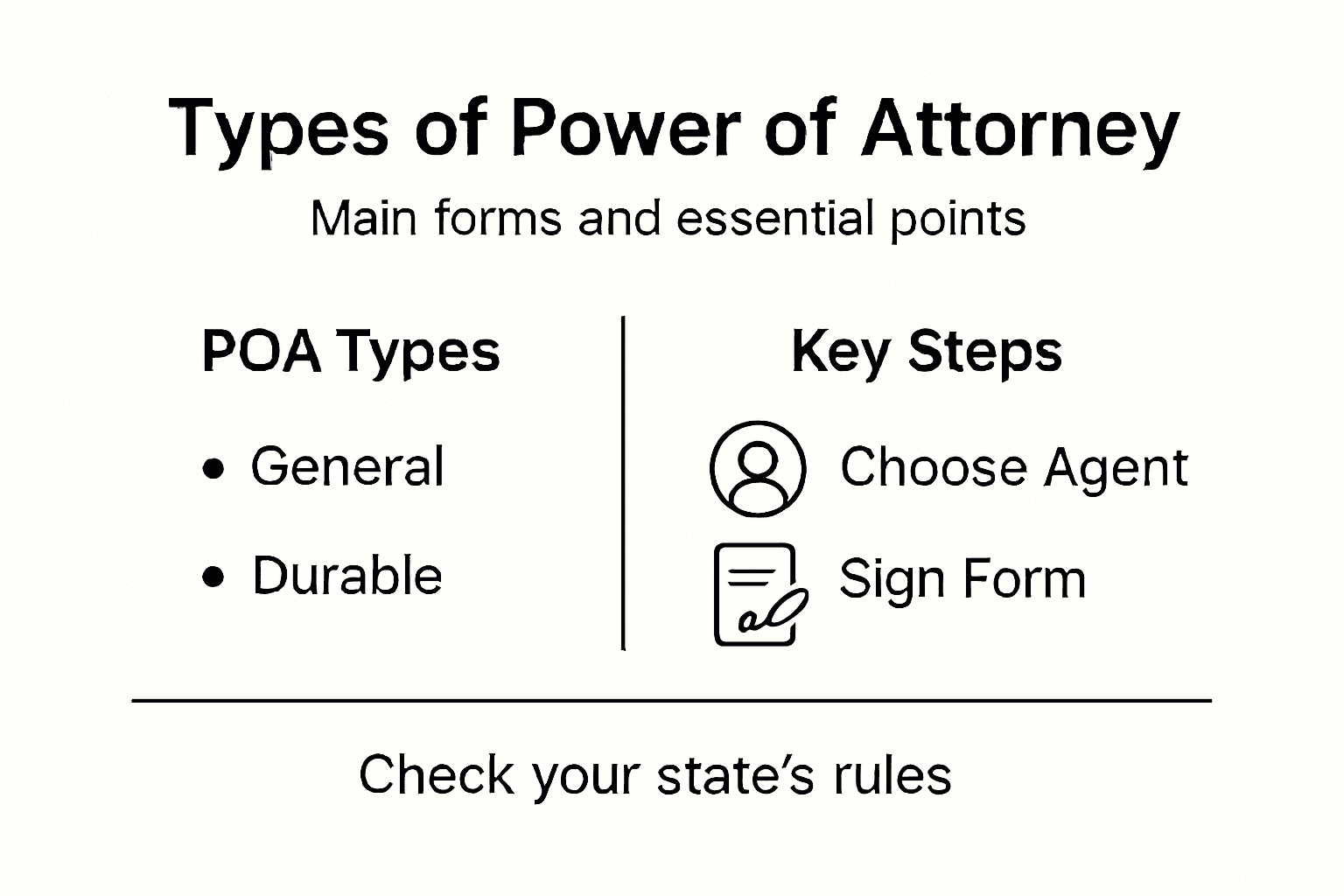
The primary types of power of attorney documents include:
-
General Power of Attorney
- Provides broad legal authority
- Covers most financial and personal decisions
- Typically becomes invalid if the principal becomes incapacitated
-
Limited/Special Power of Attorney
- Restricts agent’s authority to specific transactions
- Ideal for single purposes like real estate sales
- Expires after completing designated tasks
-
Durable Power of Attorney
- Remains valid even if principal becomes mentally incapacitated
- Continues legal representation during critical periods
- Protects ongoing financial and personal management
-
Healthcare Power of Attorney
- Focuses exclusively on medical decision-making
- Allows agent to make healthcare choices when principal cannot
- Covers treatment preferences, medical interventions
Caregiving resources emphasize that power of attorney documents vary significantly by state. Understanding these variations is crucial for creating a legally robust document that truly reflects your wishes.

Here’s a concise comparison of the main power of attorney document types:
| Type of POA | Scope of Authority | Validity Condition | Typical Uses |
|---|---|---|---|
| General | Broad financial & personal | Ends on incapacity | Routine financial matters |
| Limited/Special | Specific tasks only | Ends after task completion | Real estate transactions |
| Durable | Comprehensive, ongoing | Stays valid if incapacitated | Long-term financial care |
| Healthcare | Medical decisions only | Used when principal unable | Medical treatment choices |
Key Differences Between POA Types:
- Scope of authority
- Duration of legal effect
- Specific decision-making powers
- Activation conditions
Important: Always consult a legal professional to ensure your power of attorney document meets your specific needs and complies with state regulations.
Pro tip: Review and update your power of attorney documents periodically to ensure they accurately reflect your current life circumstances and legal requirements.
How Does a Power of Attorney Work?
Power of attorney operates through a legal mechanism that allows one person (the principal) to grant decision-making authority to another individual (the agent). Legal resources explain the fundamental process as a carefully structured delegation of personal and financial management rights.
The core mechanics of a power of attorney involve several critical components:
- Principal’s Authorization: The individual creating the document specifies exact powers
- Agent’s Responsibilities: The appointed person must act in the principal’s best interests
- Scope of Decision-Making: Powers can range from extremely limited to broadly comprehensive
- Legal Documentation: A formal written document establishes the legal framework
Key Operational Steps:
- Principal drafts and signs the power of attorney document
- Agent accepts the designated responsibilities
- Third parties verify the document’s authenticity
- Agent begins making authorized decisions
American Bar Association guidance highlights that agents must present the document to validate their authority during transactions. This might involve showing the power of attorney when:
- Accessing bank accounts
- Selling real estate
- Making medical decisions
- Managing financial investments
Important Distinction: The agent’s authority is not unlimited and must strictly conform to the document’s specified powers.
Activation Mechanisms:
- Immediate Effect: Powers begin immediately upon signing
- Springing Effect: Powers activate only under specific conditions
- Conditional Activation: Triggered by predetermined events like incapacitation
Pro tip: Always maintain multiple certified copies of your power of attorney document and communicate clearly with your chosen agent about your expectations and limitations.
Legal Requirements and Execution
Legal requirements for power of attorney documents vary across different jurisdictions, but fundamental principles remain consistent. Legal resources outline specific documentation standards that ensure the document’s validity and effectiveness.
Core Legal Prerequisites:
- Principal must be mentally competent when creating the document
- Document requires clear, explicit language defining powers
- Signatures must be voluntary and without undue influence
- Specific formatting requirements vary by state
Execution Process:
- Verify principal’s mental capacity
- Draft comprehensive document detailing authorized actions
- Obtain necessary witness or notary signatures
- Distribute certified copies to relevant parties
American Bar Association guidance emphasizes that state-specific regulations can significantly impact document validity. Some key considerations include:
- Notarization requirements
- Witness participation rules
- Specific language for durable provisions
- Registration processes for certain transactions
Critical Warning: Failure to meet precise legal standards can render the entire power of attorney document invalid.
State-Level Variations:
- Notarization: Some states mandate notary authentication
- Witness Requirements: Number and qualifications differ by jurisdiction
- Registration: Certain transactions require additional documentation
- Durability Clauses: Specific language must be used
Pro tip: Consult a local attorney to ensure your power of attorney document precisely meets your state’s specific legal requirements and standards.
Rights, Duties, and Common Pitfalls
Fiduciary responsibilities are the cornerstone of power of attorney relationships, defining the legal and ethical obligations between the principal and agent. Legal resources outline critical fiduciary standards that govern an agent’s conduct and decision-making authority.
Agent’s Fundamental Rights and Duties:
- Act exclusively in the principal’s best interests
- Maintain complete financial transparency
- Avoid conflicts of interest
- Make decisions consistent with known principal preferences
- Keep accurate and detailed records of all transactions
Potential Abuse Scenarios:
- Unauthorized financial transactions
- Making decisions beyond specified powers
- Self-dealing or personal financial gain
- Ignoring principal’s known wishes
American Bar Association guidelines emphasize that agents must navigate complex legal and ethical boundaries. Critical considerations include:
- Strict limitations on personal financial benefits
- Requirement for documented decision-making
- Potential legal consequences for misconduct
- Ongoing accountability to the principal
Warning: Power of attorney abuse can result in significant legal penalties, including civil litigation and criminal charges.
Key Protective Strategies:
Below is a summary of common pitfalls and protective strategies regarding agent duties:
| Common Pitfall | Consequence | Protective Strategy |
|---|---|---|
| Unauthorized transactions | Legal disputes, penalties | Define clear spending limits |
| Ignoring principal’s wishes | Loss of trust, litigation | Set documented preferences |
| Self-dealing | Criminal charges possible | Require periodic account review |
| Poor record keeping | Financial mismanagement | Mandate detailed transaction logs |
- Choose agents with demonstrated integrity
- Clearly define scope of authority
- Implement periodic financial reviews
- Consider multiple oversight mechanisms
Pro tip: Create a detailed communication protocol with your chosen agent to ensure transparent and aligned decision-making.
Secure Your Affairs Today With Trusted Legal Forms
Understanding the importance of a power of attorney is the first crucial step to protecting your personal and financial well-being. This article highlights challenges such as managing decision-making power, avoiding abuse, and ensuring legal compliance when appointing an agent. You deserve clear and customizable solutions that reflect your wishes while giving you peace of mind.

Take control now by creating your own power of attorney document with confidence at forms.legal. Our platform offers attorney-crafted templates designed for easy personalization so you can secure your rights before unexpected situations arise. Avoid costly legal complications and enjoy the simplicity, speed, and affordability of preparing your legal paperwork online. Visit forms.legal to start creating legally valid documents with clear authority definitions and protections for your future.
Frequently Asked Questions
What is a power of attorney?
A power of attorney is a legal document that allows one person to make decisions and act on behalf of another, particularly in financial, personal, or medical matters when the individual is unable to do so themselves.
What are the different types of power of attorney?
The main types include General Power of Attorney, Limited/Special Power of Attorney, Durable Power of Attorney, and Healthcare Power of Attorney, each designed for specific purposes and levels of authority.
How does a power of attorney work?
A power of attorney works by allowing the principal to draft and sign a document that specifies the authority granted to the agent, who can then make decisions in accordance with the powers defined within the document.
What are the rights and duties of an agent with power of attorney?
An agent with power of attorney has the duty to act in the principal’s best interests, maintain transparency, avoid conflicts of interest, and make decisions consistent with what the principal would want. They must keep accurate records and are accountable for their actions.