 -
-Securing a real estate deal often hinges on having the right agreement in place for your transaction in the United States. Accurately gathering property and party details makes a legal contract stronger, while choosing a customizable template cuts down delays. By focusing on legal property classifications and thorough due diligence, investors and managers can avoid common pitfalls and move transactions forward with confidence. This guide walks you through the practical steps to prepare agreements that meet regional legal standards and support your business goals.
Table of Contents
- Step 1: Gather Property and Party Details
- Step 2: Select and Customize the Agreement Template
- Step 3: Review and Edit Contract Terms
- Step 4: Validate Legal Compliance and Document Accuracy
- Step 5: Finalize and Execute the Real Estate Agreement
Quick Summary
| Key Point | Explanation |
|---|---|
| 1. Gather All Necessary Documents | Ensure you collect deeds, tax records, and title certificates for proper verification and accuracy. |
| 2. Choose the Right Agreement Template | Select a template suited to your region and customize it to fit your transaction specifics. |
| 3. Review Contract Terms Thoroughly | Examine each contract clause for clarity, ensuring all terms are clearly defined and understood. |
| 4. Confirm Legal Compliance | Verify your agreement meets all local legal requirements, including signatures and necessary disclosures. |
| 5. Finalize Agreement with Execution | Ensure all parties understand and sign the document, creating a legally binding agreement. |
Step 1: Gather Property and Party Details
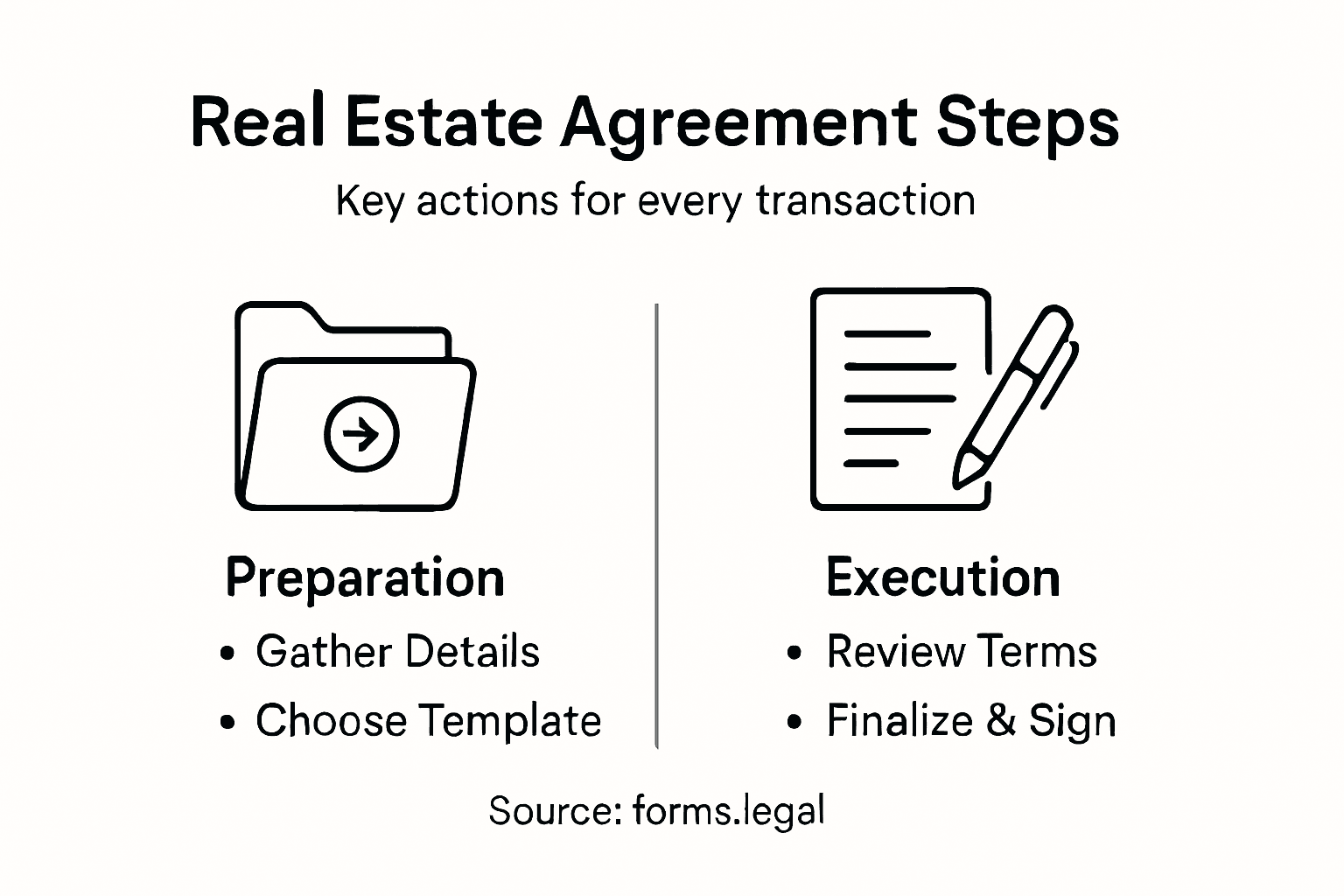
Successfully launching a real estate agreement starts with meticulous property and party information gathering. This critical first step ensures you have all the necessary details to create a legally sound transaction.
Begin by comprehensively documenting the property specifics. Legal property classifications vary widely, so confirm the precise real estate type and ownership status. Request official documentation like property deeds, tax records, and title certificates. Verify the complete legal names and contact information for all parties involved in the transaction, including current property owners, potential buyers, real estate agents, and any representatives.
Pay special attention to verifying ownership details. Thorough due diligence protects both buyers and sellers by ensuring accurate property information. Collect financial records that demonstrate property value, outstanding mortgages, liens, and any encumbrances that could impact the transaction. Request government-issued identification from all parties to confirm their legal identities and ability to enter into a binding agreement.
Pro tip: Create a dedicated digital folder to organize all gathered documents and information, ensuring easy access and comprehensive record-keeping throughout the real estate agreement process.
Here is a summary of essential documents required for real estate agreement preparation:
| Document Type | Purpose | Who Provides |
|---|---|---|
| Property Deed | Confirms ownership and boundaries | Current owner |
| Tax Records | Verifies payment history and liabilities | Seller or city office |
| Title Certificate | Ensures property is free of title defects | Title company |
| Government ID | Confirms party identity and legal capacity | All parties involved |
| Financial Statements | Indicates property value and encumbrances | Seller |
Step 2: Select and Customize the Agreement Template
Selecting the right real estate agreement template is crucial for protecting your interests and ensuring a smooth transaction. This step will help you navigate the process of finding and tailoring a template that meets your specific needs.

Start by exploring standard real estate agreement templates that provide a solid legal foundation. These templates typically include key sections covering property description, purchase price, contingencies, and closing terms. Look for forms specific to your state or region, as form libraries often offer localized templates that account for regional legal requirements. Carefully review each section and be prepared to add specific addenda or modify clauses to address unique aspects of your particular transaction.
Customization is key to creating a comprehensive agreement. Pay close attention to specific terms like financing contingencies, home inspection provisions, repair responsibilities, and closing date specifications. Consider consulting with a real estate attorney to ensure your modified template covers all necessary legal protections. Read through each section meticulously, filling in specific details about the property, parties involved, and transaction terms with precision and clarity.
Pro tip: Always maintain a clean original copy of the template and work on a separate copy to preserve the standard language and make tracking your specific modifications easier.
Step 3: Review and Edit Contract Terms
Reviewing and editing contract terms is a critical step that protects your legal interests and ensures a clear understanding between all parties. Your careful attention during this phase can prevent potential misunderstandings and future disputes.
Begin by thoroughly examining each section of the contract using contract modification best practices. Pay special attention to key provisions such as purchase price, contingencies, closing dates, and property condition assessments. Look for any ambiguous language that could potentially create confusion. Drafting contracts with clarity requires precise language that leaves no room for multiple interpretations. Verify that all financial terms are explicitly stated, including deposit amounts, financing conditions, and any potential penalty clauses.
Ensure you understand every clause before agreeing to its terms. If any section seems complex or unclear, consider consulting a real estate attorney who can provide professional guidance. Cross reference each term with local real estate regulations and verify that all required disclosures are included. Be prepared to negotiate modifications that protect your interests while maintaining a fair agreement for all parties involved.
Pro tip: Create a separate document to track specific questions or potential modifications during your contract review, allowing you to systematically address each concern before finalizing the agreement.
This table compares types of contract modifications commonly found in real estate agreements:
| Modification Type | Typical Usage Example | Impact on Transaction |
|---|---|---|
| Addenda | Including new contingency clause | Adds additional protection |
| Amendment | Changing closing date | Adjusts original timeline |
| Rider | Adding disclosures or repairs | Clarifies responsibilities |
| Supplement | Attaching inspection results | Provides extra documentation |
Step 4: Validate Legal Compliance and Document Accuracy
Ensuring your real estate agreement meets all legal requirements is a critical step that protects your financial and property interests. This process requires meticulous attention to detail and a systematic approach to document verification.
Begin by examining the legal documentation requirements that make an agreement legally valid. Verify that the document includes all essential elements such as clear intent, specific terms, legal capacity of all parties, and proper signatures. Check that each section accurately reflects the agreed upon terms and complies with local and state real estate regulations. Pay special attention to financial provisions, property descriptions, contingency clauses, and disclosure requirements. Each detail matters in creating a legally sound document.
Consult local resources like compliance departments to understand specific regional requirements that might impact your real estate transaction. Cross reference the agreement against standard legal templates and consider having a professional real estate attorney review the document for potential issues. Verify that all parties have the legal capacity to enter the agreement and that all necessary signatures are present. Confirm that witness requirements are met and that any required notarizations are completed accurately.
Pro tip: Create a comprehensive checklist of legal compliance requirements specific to your state and property type to ensure you do not overlook any critical validation steps.
Step 5: Finalize and Execute the Real Estate Agreement
Finalizing and executing your real estate agreement marks the culmination of your careful preparation and negotiation. This critical step transforms your documented agreement into a legally binding contract that protects all parties involved.
Begin by carefully reviewing the agreement execution process to ensure legal validity. Gather all required parties for the signing ceremony and verify that each individual understands and willingly commits to the terms. Confirm that everyone has proper identification and legal capacity to sign. Consider whether electronic signatures are acceptable or if original wet signatures are required. Pay close attention to the order of signatures and ensure all pages are initialed where necessary.
Understand the legal implications of contract execution and title transfer. This moment represents a binding commitment where all contingencies and agreed terms become legally enforceable. Verify that witnesses are present if required by local regulations and that the document is properly notarized. Make multiple copies for all parties and ensure each receives a complete set of signed documents. Store your copies in a secure location and create digital backups as an additional precaution.
Pro tip: Schedule the signing in a neutral location with ample time for careful review and create a calm environment that allows all parties to read and understand the final document without feeling rushed.
Simplify Your Real Estate Agreement Journey with Trusted Legal Templates
Mastering the real estate agreement process requires careful attention to detail, clear contract terms, and strict legal compliance. Many face challenges like customizing contract templates, ensuring legal accuracy, and avoiding costly mistakes. With complex clauses and regional rules, it is easy to feel overwhelmed or unsure if your documents truly protect your interests.
forms.legal offers a powerful solution to these challenges by providing easy access to attorney-crafted, customizable real estate agreement templates. Whether you are gathering essential property details or finalizing and executing contracts, our platform helps you create clear, accurate, and legally compliant documents faster and with confidence. Explore our broad selection of legal forms designed to meet your needs and reduce dependence on expensive legal consultations.
Ready to take control of your real estate agreements? Start today with the comprehensive resources available at forms.legal.
Looking for a streamlined way to customize the perfect agreement? Visit customizable legal documents to find your ideal template and begin tailoring it to your specific transaction.
Don’t let paperwork delay your success. Use forms.legal now to access professionally drafted forms that simplify your process and protect your interests every step of the way.
Frequently Asked Questions
What essential documents do I need for a real estate agreement?
To prepare a real estate agreement, you need key documents such as the property deed, tax records, title certificate, government IDs, and financial statements. Begin by gathering these documents to ensure accuracy and completeness in your transaction.
How do I customize a real estate agreement template?
To customize a real estate agreement template, start by selecting a standard template that fits your needs. Carefully review each section, adding specific terms such as financing contingencies, inspection provisions, and any unique requirements for your transaction.
What should I look for when reviewing contract terms?
While reviewing contract terms, focus on provisions like the purchase price, contingency clauses, and closing dates. Ensure that all terms are clear and unambiguous to prevent misunderstandings; consult legal resources if any sections seem complex.
How can I ensure my real estate agreement is legally compliant?
To ensure legal compliance, verify that your agreement includes essential elements such as clear intent, specific terms, and proper signatures. Create a checklist of your local legal requirements and cross-check your agreement against this list to confirm accuracy.
What steps should I take to finalize the real estate agreement?
To finalize the agreement, gather all parties for a signing meeting and ensure everyone has the necessary identification. Confirm that all required signatures are in place, and make multiple copies of the signed document for secure distribution to all involved parties.