 -
-Protecting your secret sauce from competitors is a constant worry for many small business owners in the United States. With confidential client lists, unique business plans, and trade secrets on the line, figuring out the right way to secure sensitive information can feel overwhelming. Non-disclosure agreements (NDAs) offer clear legal protection without forcing you to spend thousands on legal fees. This guide breaks down what NDAs really are, busts common myths, and shows how to use simple, affordable tools to keep your business information safe.
Table of Contents
- Non-Disclosure Agreements Defined and Debunked
- Types of NDAs for Small Businesses
- Key Elements Included in NDAs
- Legal Requirements and Enforceability Rules
- Risks, Limitations, and Common Pitfalls
Key Takeaways
| Point | Details |
|---|---|
| Understanding NDAs | Non-disclosure agreements (NDAs) are legal contracts designed to protect confidential information, but they are not foolproof solutions. Proper drafting is crucial for enforceability and protection. |
| Types of NDAs | Choose the appropriate NDA type—unilateral, mutual, or multilateral—based on the flow of information and the specific situation to ensure clear obligations. |
| Key Elements | Essential components like the definition of confidential information, permitted use, duration, exclusions, and consequences are critical for a robust NDA. |
| Legal Validity | For NDAs to be enforceable, they must meet legal standards, including mutual assent, clear terms, and lawful subject matter, to avoid issues in court. |
Non-Disclosure Agreements Defined and Debunked
A non-disclosure agreement (NDA) is a legal contract where one or more parties agree to keep certain information confidential. Think of it as a written promise. When you sign an NDA, you’re saying “I will not share this information with anyone outside this agreement without permission.” For small business owners, NDAs protect what makes your business valuable: client lists, pricing strategies, manufacturing processes, software code, business plans, or any information that gives you a competitive edge. The agreement binds everyone who signs it to treat the protected information as confidential and not disclose it to unauthorized parties.
Now, here’s where the confusion starts. Many small business owners think NDAs are either magic documents that solve all problems or unnecessary paperwork that nobody will enforce. Neither is true. NDAs are enforceable contracts, but they have real limitations. NDAs can be misused or drafted too broadly, which weakens their effectiveness and creates problems down the line. Some business owners write NDAs so vague that a court won’t enforce them. Others include language that tries to cover things the law won’t allow them to protect, like preventing employees from discussing workplace safety concerns or reporting illegal activity. State laws also vary on what NDAs can actually cover, which means a template from the internet might not work in your jurisdiction. The goal is creating an agreement that’s specific enough to be enforceable but broad enough to protect what actually matters to your business.
Here’s what makes this practical for you: A solid NDA clearly identifies what information you’re protecting, who can access it and why, how long the confidentiality obligation lasts, and what happens if someone breaks the agreement. You can create these agreements yourself using customizable templates that handle the core protections without expensive attorney fees. The key is being realistic about what you’re protecting. If you’re sharing trade secrets with a contractor or discussing a sale of your business with potential buyers, an NDA is non-negotiable. If you’re just having a casual conversation about your business idea at a networking event, you probably don’t need everyone to sign one first. The sweet spot for most small business owners is having a simple NDA template ready when you need it, rather than trying to craft something from scratch when a situation suddenly demands it.
Pro tip: Use a customizable NDA template from forms.legal rather than hiring an attorney to draft one from scratch, which costs thousands of dollars. A well-designed template covers the essentials for most small business situations and can be customized for your specific circumstances in minutes.
Types of NDAs for Small Businesses
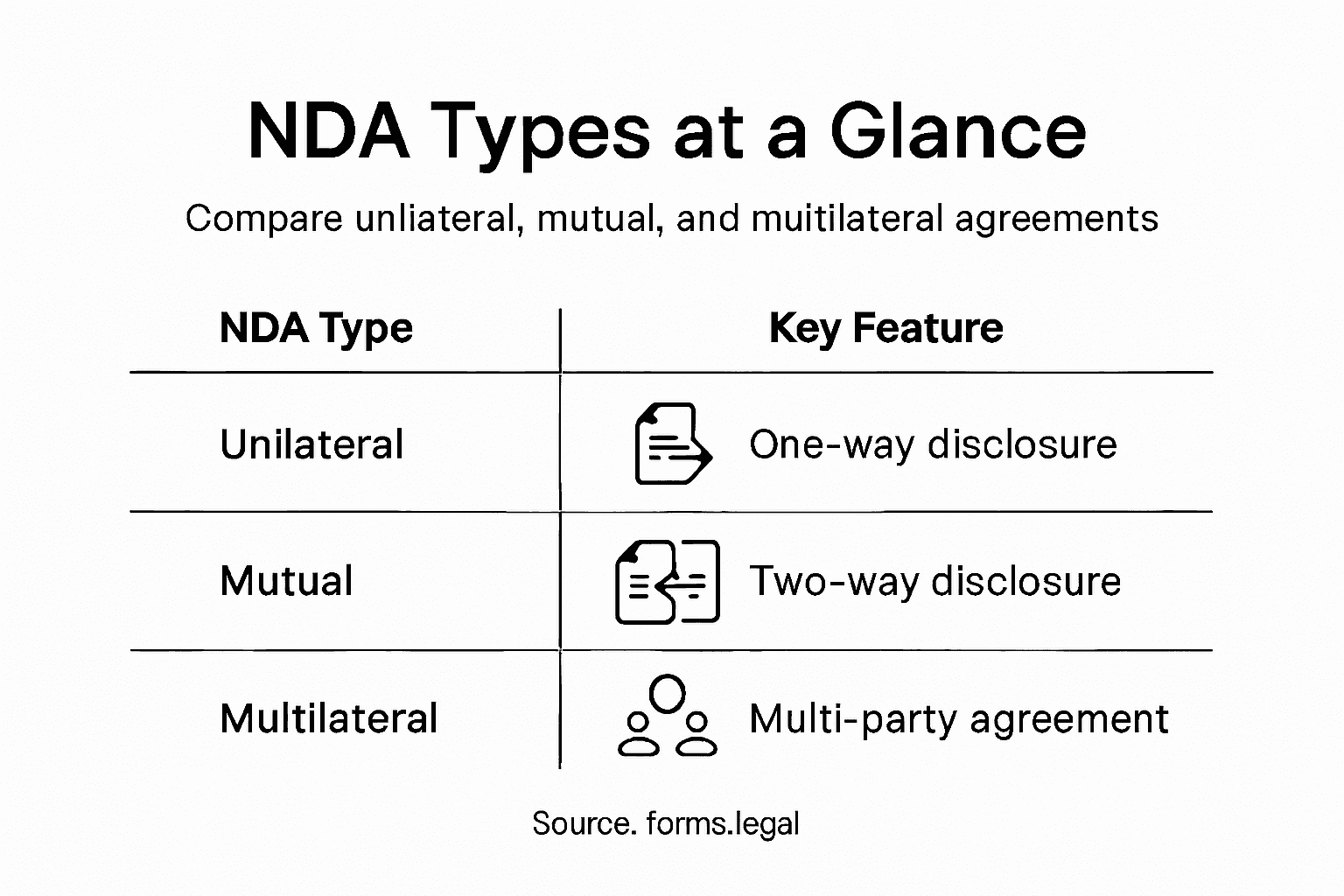
Not every situation calls for the same type of NDA. The type you choose depends on who you’re protecting information from and whether both parties need confidentiality or just one. Understanding the main categories helps you pick the right tool for your specific business scenario.
Unilateral NDAs
A unilateral NDA is the most common type small business owners use. In this agreement, only one party discloses confidential information while the other party agrees to keep it secret. You’d use a unilateral NDA when sharing trade secrets with a contractor, pitching your business to a potential investor, or letting a consultant review your operations. The contractor, investor, or consultant signs the agreement promising not to share what they learn with anyone else or use it for their own benefit. Unilateral NDAs are straightforward because you’re not asking the other party to share sensitive information back to you. This makes them simpler to draft and easier to enforce if someone breaks the agreement.
Mutual NDAs
A mutual NDA (also called a bilateral agreement) works differently. Both parties disclose confidential information to each other and both promise to keep it secret. This type makes sense when you’re exploring a partnership, joint venture, or collaborative project where information flows both directions. For example, if you’re meeting with another business to discuss merging your operations, you both need protection. You’ll share your customer data and financial information, while they share theirs. Mutual NDAs can be trickier to negotiate because both sides want their information protected equally, but they’re essential when you’re genuinely exchanging sensitive details back and forth.
Multilateral NDAs
When three or more parties need to exchange confidential information under a single agreement, a multilateral NDA consolidates everything into one document. This streamlines the process if you’re coordinating with multiple contractors, vendors, or partners on a project. Instead of everyone signing separate agreements with each other, everyone signs one document that covers all the confidentiality obligations.
The key to choosing the right type is matching it to your actual situation. If you’re one-way sharing information, go unilateral. If information flows both directions, choose mutual. If you’re working with multiple parties, consider multilateral. Key issues in NDA enforcement often stem from picking the wrong type or using generic language that doesn’t fit your specific relationship. Getting this foundation right prevents headaches down the road when you actually need to enforce the agreement.
Pro tip: Start with a unilateral NDA template for most situations since it’s simpler and covers 80% of small business scenarios, then upgrade to mutual or multilateral agreements only when your specific situation genuinely requires information to flow in multiple directions.
Here’s a quick comparison of NDA types and their typical business uses:
| NDA Type | Ideal Use Case | Information Flow | Complexity |
|---|---|---|---|
| Unilateral | Protecting trade secrets with vendors | One-way (discloser to recipient) | Simple |
| Mutual | Joint ventures or mergers | Both parties share info | Moderate |
| Multilateral | Projects with several contractors | Info exchanged among multiple parties | Most complex |
This table clarifies when each NDA structure best fits particular business scenarios.
Key Elements Included in NDAs
A well-written NDA is like a well-built fence. It only works if every section is solid and properly connected. A weak NDA won’t hold up if you ever need to enforce it in court. Small business owners often use generic templates and miss critical elements that make the difference between an enforceable agreement and expensive legal paperwork that actually protects nothing. Here’s what separates a functional NDA from a useless one.

Definition of Confidential Information
Your NDA must clearly specify what information you’re actually protecting. This is the foundation of everything. You can’t just say “all information is confidential” because a court won’t enforce something that vague. Instead, list the specific categories: trade secrets, client lists, pricing structures, manufacturing processes, software code, business plans, financial data, or whatever applies to your situation. Be specific enough that both parties understand exactly what’s covered. For example, “all customer contact information obtained during the engagement” is better than “customer data.” Clearly identifying what constitutes confidential information ensures the agreement can actually be enforced if someone violates it.
Permitted Use and Restrictions
Next, spell out what the receiving party can and cannot do with the information. Can they show it to their team members? Can they use it for their own business purposes? The answer should be no to most situations. The agreement should state that the receiving party can only use the information for the specific purpose you’ve agreed to (like evaluating a partnership or completing a project) and nowhere else. This restriction prevents the contractor from taking your client list and starting a competing business, or the investor from sharing your financial information with your competitors. Without clear use restrictions, the other party can claim they didn’t understand the boundaries.
Duration and Term
How long does confidentiality last? This matters more than you might think. Some information needs protection forever (trade secrets), while other information becomes public knowledge after a certain period. Most small business NDAs use timeframes like 2, 3, or 5 years, though you can extend this indefinitely for trade secrets. Be realistic. If you’re protecting information that loses value in 18 months, don’t ask for 10 years of confidentiality. Courts are more likely to enforce reasonable terms than ones that seem excessive.
Exclusions
Every NDA needs exclusions because some information can’t legally be kept confidential. The agreement should state that confidentiality doesn’t apply to information that is already publicly available, information the receiving party already knew before signing the NDA, or information they’re required by law to disclose. For example, if a court subpoenas your information or a government agency requires disclosure, the receiving party shouldn’t be liable. These exclusions make your NDA legally sound and enforceable.
Consequences of Breach
One element many small business owners overlook is what happens when someone breaks the agreement. Your NDA should address what penalties or actions occur if someone breaks a non-disclosure agreement. This might include injunctive relief (a court order to stop the violation), monetary damages, or attorney fees. Including specific language about remedies makes the agreement stronger and shows the other party you’re serious.
Pro tip: Don’t try to make your NDA cover everything or last forever, since courts reject unreasonable terms and won’t enforce them. Focus on protecting what actually matters to your business with specific, realistic terms that a judge would consider fair.
Below is a summary table of the essential elements that make NDAs effective:
| Element | Why It Matters | Typical Example |
|---|---|---|
| Scope of Confidentiality | Defines what is protected | Client lists, trade secrets |
| Permitted Use | Limits how info is accessed | For project evaluation only |
| Duration | Sets time period for obligations | 3 years or indefinite |
| Exclusions | Avoids illegal or public info | Info required by law not covered |
| Breach Consequences | Describes remedies and penalties | Monetary damages, injunctions |
This summary helps small business owners review NDAs for completeness and enforceability.
Legal Requirements and Enforceability Rules
Here’s the reality: you can write a perfect NDA, but if it doesn’t meet legal requirements, a court won’t enforce it when you actually need protection. Many small business owners sign agreements that look official but fail basic legal standards. Understanding what makes an NDA enforceable saves you from wasting time on paperwork that won’t hold up in court.
What Makes an NDA Legally Valid
For an NDA to be enforceable, it must meet standard contract law requirements. First, both parties need to understand what they’re signing and agree to the terms. This is called mutual assent. You can’t trick someone into signing or use deceptive language. Second, the agreement needs consideration, which means both parties get something of value from the deal. If you’re asking a contractor to keep your secrets, they’re getting the opportunity to work with you. That’s consideration. Third, the terms must be clear and specific. Vague language weakens enforceability. Finally, the subject matter must be legal. You can’t create an NDA to cover up illegal activity or protect someone from facing consequences for breaking the law.
What NDAs Cannot Protect
Courts won’t enforce NDAs that try to cover things the law specifically protects. Information involving criminal activity or illegal conduct cannot be made confidential through an NDA. If a contractor discovers you’re dumping toxic waste illegally, they can report it to the Environmental Protection Agency without violating your NDA. Similarly, whistleblower protections prevent NDAs from silencing employees who report violations to government agencies. The Speak Out Act of 2022 added another major restriction: NDAs cannot enforce confidentiality on disputes involving sexual assault or harassment unless the NDA was signed after the dispute arose. This law specifically protects victims from being silenced.
Reasonableness Standards
Courts evaluate whether NDA terms are reasonable. An agreement that lasts forever might seem extreme because information loses value over time. Most courts accept timeframes of 2 to 5 years for general business information and indefinite protection for true trade secrets. Geographic scope also matters. You can’t reasonably restrict someone globally from using information if your business only operates in three states. Overbroad restrictions that lack reasonableness get struck down or partially invalidated. Additionally, the National Labor Relations Act limits overbroad NDAs that restrict employees from discussing working conditions or wages. Your NDA might be perfectly written for protecting customer data but unenforceable if it prevents employees from discussing their salaries.
Enforceability Varies by State
NDA laws differ across states. California, for example, is notoriously restrictive on non-compete agreements and takes a narrow view of confidentiality restrictions that limit job mobility. Texas takes a different approach. New York has its own standards. This variation matters because your NDA might be enforceable in one state but not another. If you do business across state lines, you need to consider where disputes would likely be litigated and which state’s law governs your agreement.
Pro tip: Include a choice of law clause in your NDA specifying which state’s laws apply, and choose a state with well-developed case law protecting NDAs rather than leaving it ambiguous, which creates legal uncertainty and enforcement problems.
Risks, Limitations, and Common Pitfalls
NDAs seem simple on the surface, but they carry real risks if you’re not careful. Small business owners often make mistakes that weaken their agreements, create legal problems, or backfire in unexpected ways. Understanding these pitfalls helps you avoid costly errors and use NDAs strategically instead of blindly.
Overbroad Language Creates Unenforceable Agreements
The most common mistake is writing an NDA so broad that courts won’t enforce it. Phrases like “all information related to the business” or “anything you might learn” are too vague. Judges hate ambiguity because it forces them to guess what you meant. When an NDA is unclear, courts typically rule against the person who wrote it. Another problem is trying to protect information that isn’t actually confidential or proprietary. Your customer’s name might be public knowledge in your industry. Your pricing might be standard for your market. If you’re trying to keep something confidential that competitors already know, a court won’t protect it. Overly broad NDAs that lack reasonableness often get struck down entirely or modified by judges, which leaves you with weaker protection than a more carefully written agreement would have provided.
Misuse as a Silencing Tool
Here’s something many business owners don’t realize: NDAs can become legal liabilities if they’re used to silence people inappropriately. There’s a difference between protecting legitimate business secrets and using an NDA to prevent someone from reporting misconduct. Broad and vague NDA language can silence workplace harassment victims and prevent them from seeking justice, which creates serious legal and ethical problems. If an employee reports sexual harassment or discrimination to a government agency, your NDA won’t stop them and shouldn’t try to. If a contractor witnesses illegal activity, they can report it. Using NDAs to suppress these disclosures opens you to lawsuits and regulatory action. The key is ensuring your NDA protects confidential business information, not misconduct.
Enforceability Challenges When You Actually Need Protection
Many small business owners discover their NDA doesn’t work when they actually try to enforce it. The person who violated it claims the NDA is too vague or that the information wasn’t truly confidential. They argue the timeframe is unreasonable. They claim they already knew that information before signing. If you end up in court, you’ll need proof that your agreement meets all legal requirements. Vague NDAs create doubt. Indefinite terms get challenged. Information that seems obvious to you might not seem confidential to a judge. You also need evidence of actual damage. If someone violated your NDA but you can’t prove you lost money or suffered harm, courts might not award significant damages.
The Cost of Enforcement
Even a well-written NDA requires money to enforce. Taking someone to court over a breach costs thousands of dollars in attorney fees. You’ll need to prove the breach happened, quantify your damages, and show the violation caused real harm. For a small business protecting a customer list worth $50,000, spending $30,000 on legal fees to enforce your NDA might not make financial sense. This is why NDAs work best as prevention, not cure. They deter violations through clear expectations and serious language. But if someone is determined to violate your agreement, be realistic about whether legal action is worth the cost.
Pro tip: Use NDAs strategically by keeping them focused, specific, and reasonable rather than trying to make them airtight protections for everything, which backfires because overbroad agreements are harder to enforce and create more legal exposure.
Protect Your Business Secrets with Confidence Using Customizable NDAs
Navigating the complexities of non-disclosure agreements can be challenging. This article highlights key pain points such as avoiding vague NDA language, choosing the right type of agreement, and ensuring enforceability that truly protects your business interests. If you want to avoid costly mistakes and create focused, clear NDAs that reflect your specific needs – you are not alone. Small business owners often struggle with balancing solid confidentiality protections against legal limitations.
Take control today by using customizable NDA templates tailored for your situation. At forms.legal, you get access to attorney-crafted agreements that cover key elements like defining confidential information, realistic duration, and breach consequences without the high costs of hiring a lawyer. Start building enforceable NDAs that prevent misuse and protect your valuable business secrets. Don’t wait until a breach happens; empower your business with the right legal tools now at forms.legal.
Frequently Asked Questions
What is a non-disclosure agreement (NDA)?
A non-disclosure agreement (NDA) is a legal contract where parties agree to keep certain information confidential, preventing unauthorized sharing of sensitive information.
When should I use a unilateral NDA?
You should use a unilateral NDA when only one party is disclosing confidential information, such as when sharing trade secrets with contractors or pitching to investors.
What are the key elements of an enforceable NDA?
An enforceable NDA should clearly define the confidential information, outline permitted uses and restrictions, specify the duration of the agreement, include necessary exclusions, and detail the consequences of breach.
Why are NDAs important for small businesses?
NDAs are crucial for small businesses as they protect valuable information such as client lists, pricing strategies, and trade secrets, helping to maintain a competitive edge within the market.